
Shopping malls & commercial plazas
- Problem fit
- The demonstrated setting: one bulk utility connection, many metered shops and a property team handling collection.
- What changes
- Configure the property’s meters, rates, roles and billing periods.
Page updated
WattEY Metering is a meter-reading and tenant-billing system built by Ali Ahmed at Wattey Energy (formerly BijliBachao.pk). An Android app captures photographs and confirmed readings; a web portal reviews the evidence, generates bills, tracks arrears and freezes monthly records. The 25 August 2026 production snapshot documents five closed billing cycles and 668 photographed readings at Mall of Mureedkay, a shopping mall in Punjab.
I built the field-to-finance workflow: an Android capture app, the reading review process, and the portal that bills tenants and closes the month.
 Ali AhmedHead of Energy Systems & Product EngineeringFigures as of 25 August 2026 · Mall of Mureedkay
The reading
17,261.64
kWh · previous 17,056
image keptBuilt at
BijliBachao.pk
an engineering design house that builds its own software rather than buying it
In production
A live property
a ~545-unit property, with 129 shops onboarded and ~111 active meters billed monthly · since 5 March 2026
What it unlocked
Solar Share System
A Wattey Energy (formerly BijliBachao.pk) service — solar EPC sold on the strength of a bill nobody disputes
A man walked the building with a notebook. Someone retyped it into a spreadsheet nobody could audit. Once a month a shopkeeper said the reading was wrong, and there was no proof either way.
Started
0proof behind a reading
A mobile app that walks the property floor by floor, photographs every meter face and reads the digits off the image — then hands the number to an operator to confirm, because billing accuracy should not depend on a model being right.
Built
668readings · every one photographed
One published formula, computed identically for every shop and shown to the party being charged. Common area held apart, solar credited, arrears carried forward.
Delivered
1formula, shown to both sides
A whole property closing every month into a frozen, read-only ledger — with the rule that nobody gets billed twice enforced by the database rather than by the application.
Scaled
5consecutive cycles closed
A rooftop became sellable. With a bill the tenants accept, the owner can credit solar units against grid units — and BijliBachao sells that as a service it calls a Pakistan first.
Outcome
1service line, made possible
A Pakistani mall buys electricity in bulk on one connection and has to recover it from hundreds of shops. The utility does not do that for them — sub-billing is the owner’s problem, and almost everywhere it is done by hand. These are the five failures that follow, as the platform team lists them from the field rather than from imagination.
Someone walks the building writing numbers into a register. Transposed digits and skipped meters cost real money every month, and are found only when a tenant complains.
A tenant says the bill is too high. The owner has a handwritten number and nothing else. Arguments drag, payments stall, relationships sour.
Walking a property of this size by hand takes a full working day; typing the numbers up and computing bills takes days more. Bills go out late, so money comes in late.
Supply, tenant consumption and common-area use need to be compared over aligned periods. An unexplained difference requires investigation rather than being assumed to be theft.
The one nobody sees coming.
Without frozen period records and an audit trail, changing a rate or tenant record can alter historical bills. The system separates current configuration from closed-period snapshots.
What WattEY Metering changed
The deliverable was never the invoice. It was the evidence behind it.
And the positioning falls out of the same observation, in the platform team’s own words: sub-metering hardware exists and utility software exists, but nothing served the owner in the middle who buys bulk and re-bills retail.
The mobile app is part of the delivered system. Operators use it to select a meter, photograph the display, confirm the reading and send it to the billing team. The Android app is built with React Native and Expo.
Floor-ordered shop lists and a meter picker keep the route organised. Unread meters and retake requests stay visible.
A camera alignment guide frames the display. The app retains the full photograph and the cropped meter display alongside the confirmed value.
Readings and images queue in local storage when connectivity is unavailable. Uploads resume when the connection returns; failures remain visible for retry.
The portal receives readings for review, including retakes. Cloud OCR uses the web application’s authenticated proxy and requires a connection; offline capture uses operator entry.
The codebase supports an iOS build, but no iOS distribution is established by this case study.
Meter 014
17,261.64kWh
Android field app · Web management portal
Deployment figures on this page are the 25 August 2026 snapshot; source inspection confirms features, not new production totals.
01The hard part
Attaching a picture to a meter reading is the easy idea, and it is where most photo-verified billing stops. It does not survive a real dispute — because a photograph taken and approved by the same person proves nothing that a handwritten number did not already prove.
The conversation the software has to win
Eight properties · remove one and the rest stop meaning anything
Every reading stores its photograph and timestamp, and the photograph appears both in the dashboard and on the printed bill. There is no "trust me" anywhere in the chain.
Without it, the reading is one person’s word.
Connected capture requests server time. Offline capture, or a failed server-time request, uses the device clock and preserves that time with the queued record. This is an operational timestamp, not a universal guarantee against clock changes.
Connected capture uses server time when available; offline capture still depends on the device clock.
The moment a bill is paid, and again when the month closes, the whole bill freezes — readings, rate, factor, tax, tenant, shop, floor. Changing a rate or renaming a tenant later can never rewrite a past bill.
Without it, changing a rate today silently rewrites what somebody was charged last year.
Ledger records are never physically destroyed. A "deleted" record is flagged, attributed and recoverable, so a deletion is part of the history rather than a hole in it.
Without it, a deletion is a hole in the history rather than part of it.
Reopening a closed month asks for confirmation, is re-checked by the application, and is blocked outright at the database whenever it could bill a tenant twice for the same month.
Without it, an honest correction can bill a tenant twice for the same month.
The database constrains original readings to one per meter per month and checks that the previous billing month is closed. Retakes are exempt from the original-reading uniqueness rule and are resolved separately by the billing workflow.
Without it, one stale app version is all it takes to break the rule everywhere.
Months record who closed them, payments record who marked them, deactivations and deletions record the actor. "Who did this?" is answered by the record rather than by argument.
Without it, “who did this?” is settled by argument.
Only the most senior role can reopen a month, delete a reading, or set a meter’s opening value. Billing staff can record money coming in but cannot quietly reverse a payment — that needs a level above them.
Without it, the person who records the money can also make it disappear.
Not a diagram — the shipped product
Two of the five links are visible on one screen. Every row carries a confidence score beside its reading, and the action available on a bad one is Request Retake — not edit.
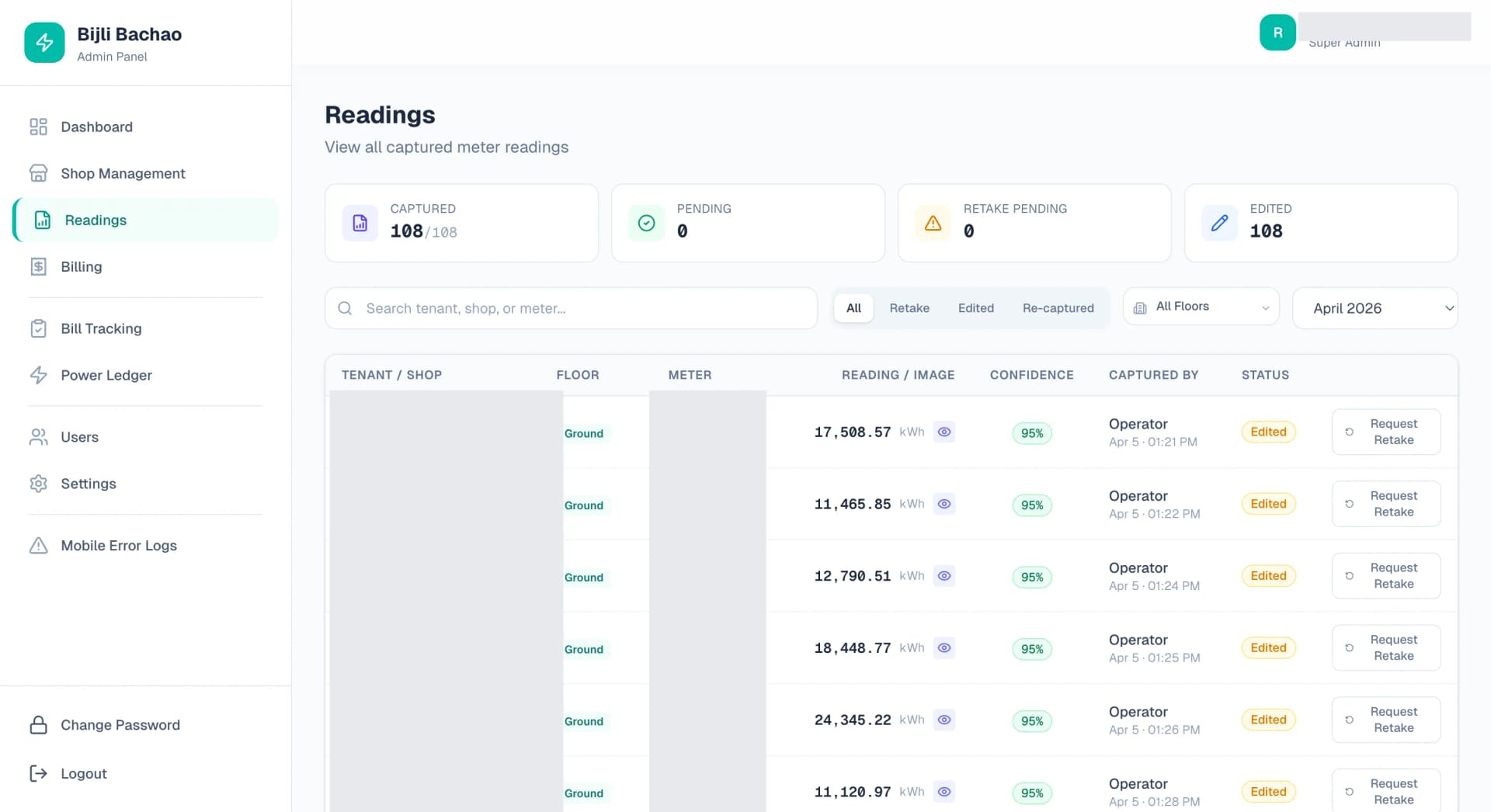
The camera proposes a value, a person confirms it against the photograph, and the photograph stays attached to the bill. All 668 readings in the dated production snapshot carry an image. An OCR confidence score is not a measured accuracy rate or a record of independent approval.
A disputed or unreadable capture is re-photographed under audit. The original stays in the record, so a correction is visible as a correction.
Signal-dead corridors are expected, so the app captures without a network and syncs later. Because extraction runs through that proxy it needs connectivity; a capture taken offline still photographs the meter and defers the reading to operator entry. The database limits original readings to one per meter per month; linked retakes are separate records.
Where the chain ends
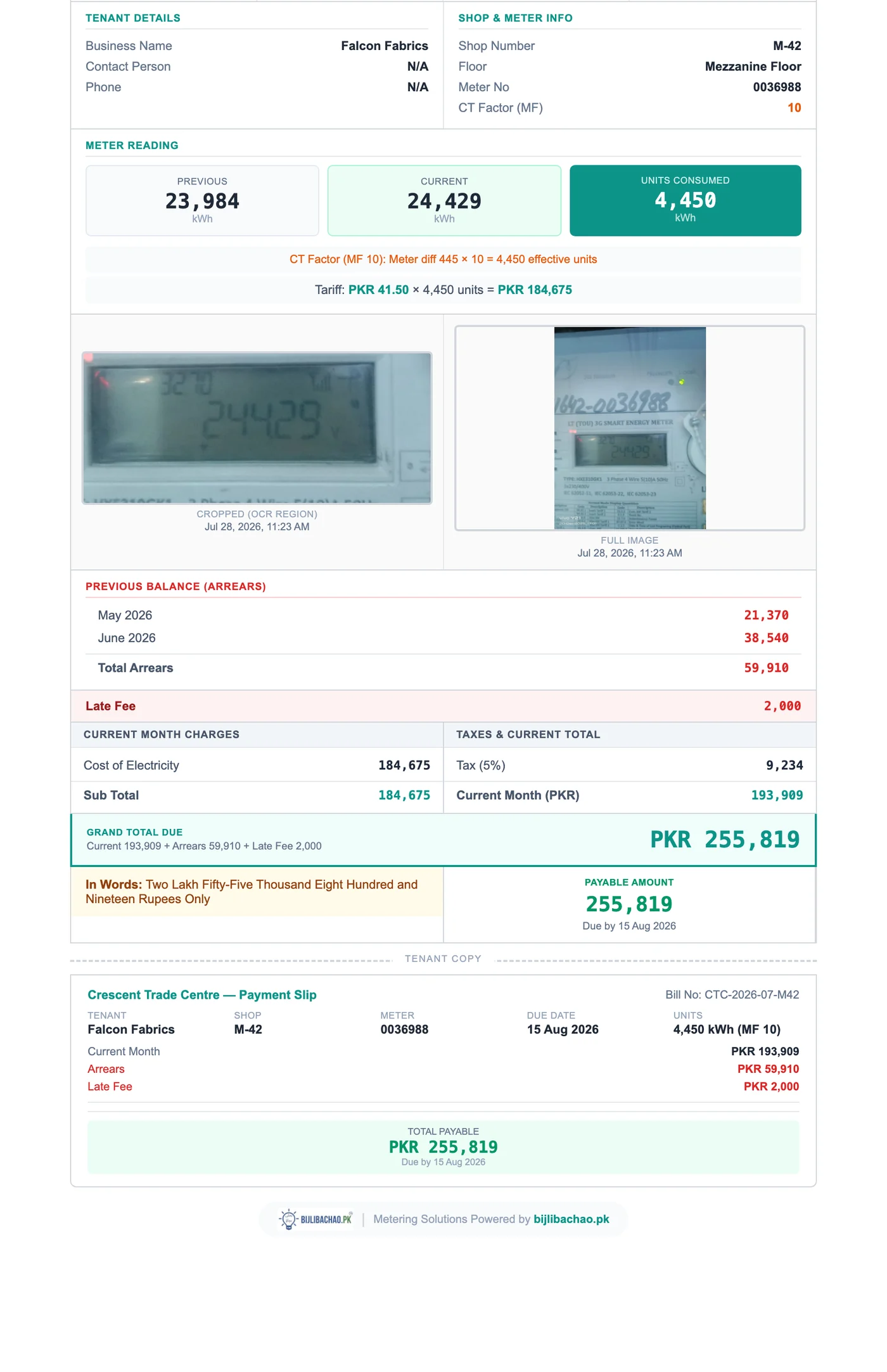
Two photographs of the meter are printed on the bill — the cropped display and the full face, both timestamped. A tenant disputing the figure is not asked to trust a database; they are holding the picture.
Look at the photograph and then at the reading. That correspondence is the entire argument of this chapter, and it is checkable on the paper by the person being billed.
A CT-metered connection reads a fraction of the real current and must be multiplied up. The bill prints “meter difference 445 × 10 = 4,450 effective units” — so the step most likely to be disputed is the step most visibly worked out.
Two carried months and the late fee are itemised above the current charge, and the grand total shows its own components. Nothing about the number requires an explanation over a counter.

The bill was never the product. The product was making the bill impossible to argue with.
Any spreadsheet can produce an invoice. Almost none can defend one.
02The month has to close
“The numbers never quite add up” is not a complaint about arithmetic. It is that the tenant invoices and the utility bill describe two different worlds, and the gap between them is the owner’s loss with no name on it. Reconciling the four quantities is what turns billing software into a book of account.
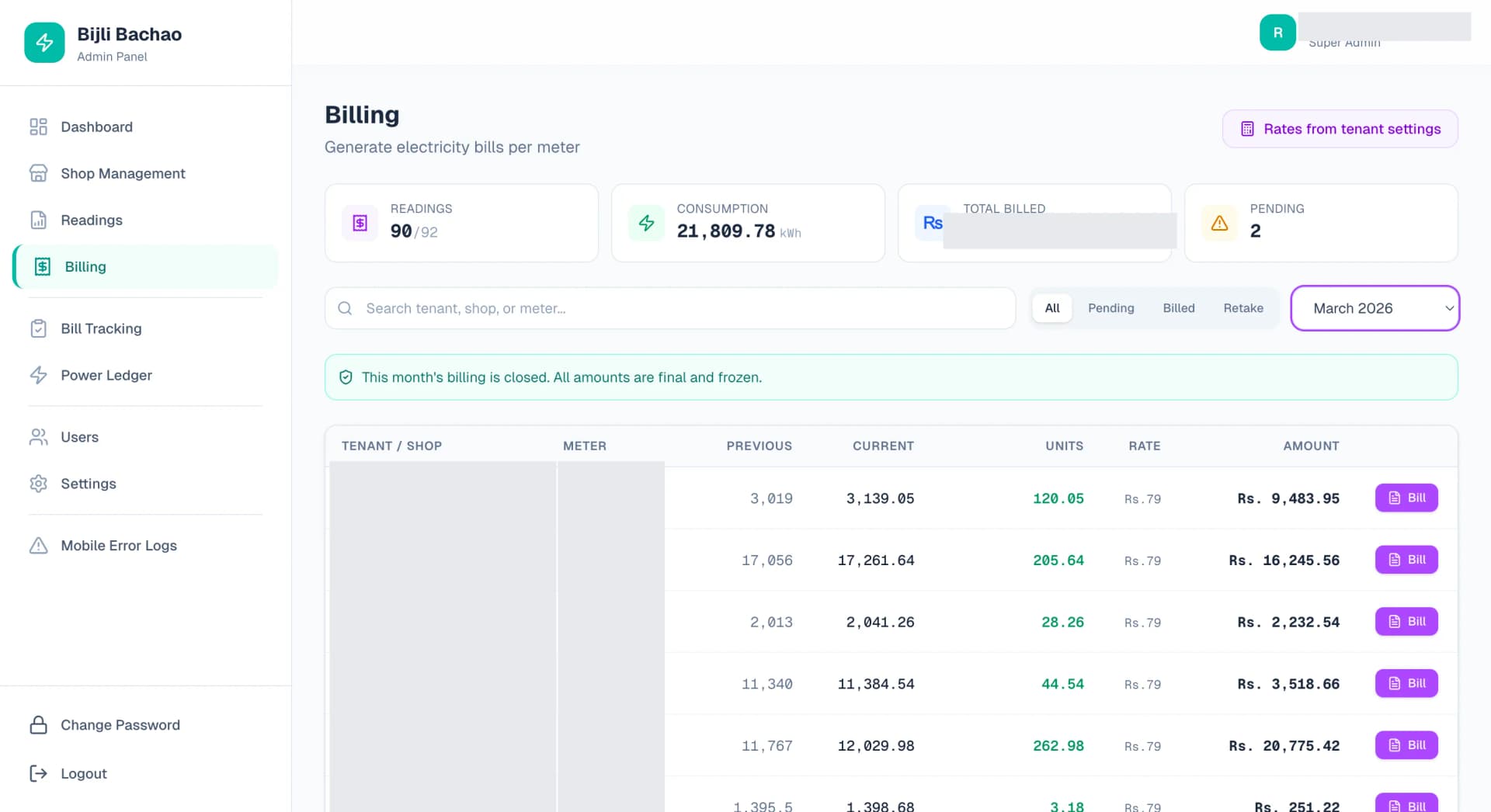
One property · March 2026
Solar is credited against building consumption without being counted twice, and shared lighting and lifts are billed to the building rather than back to a shop. No rupee figure from this property is published anywhere on this page.
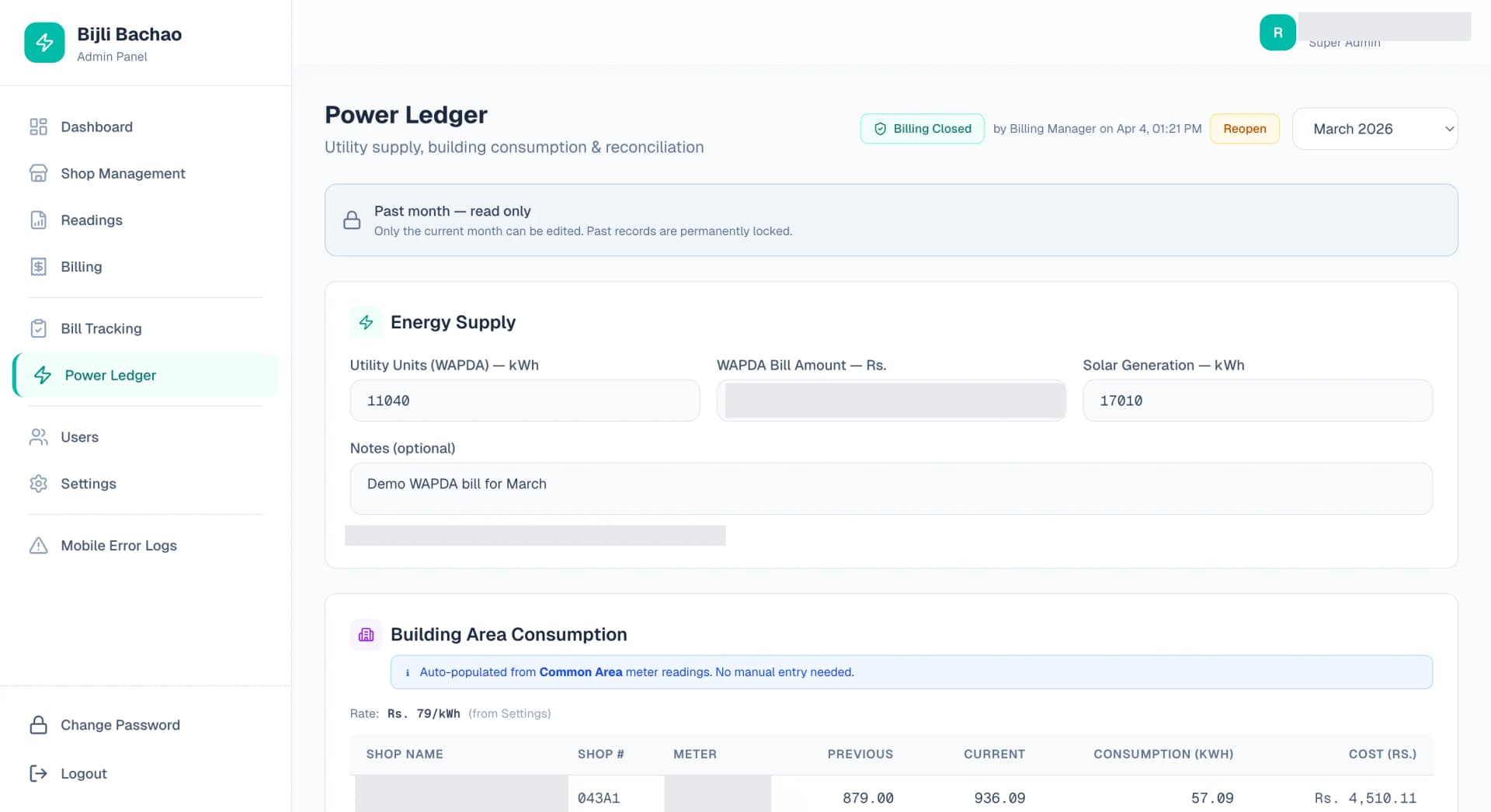
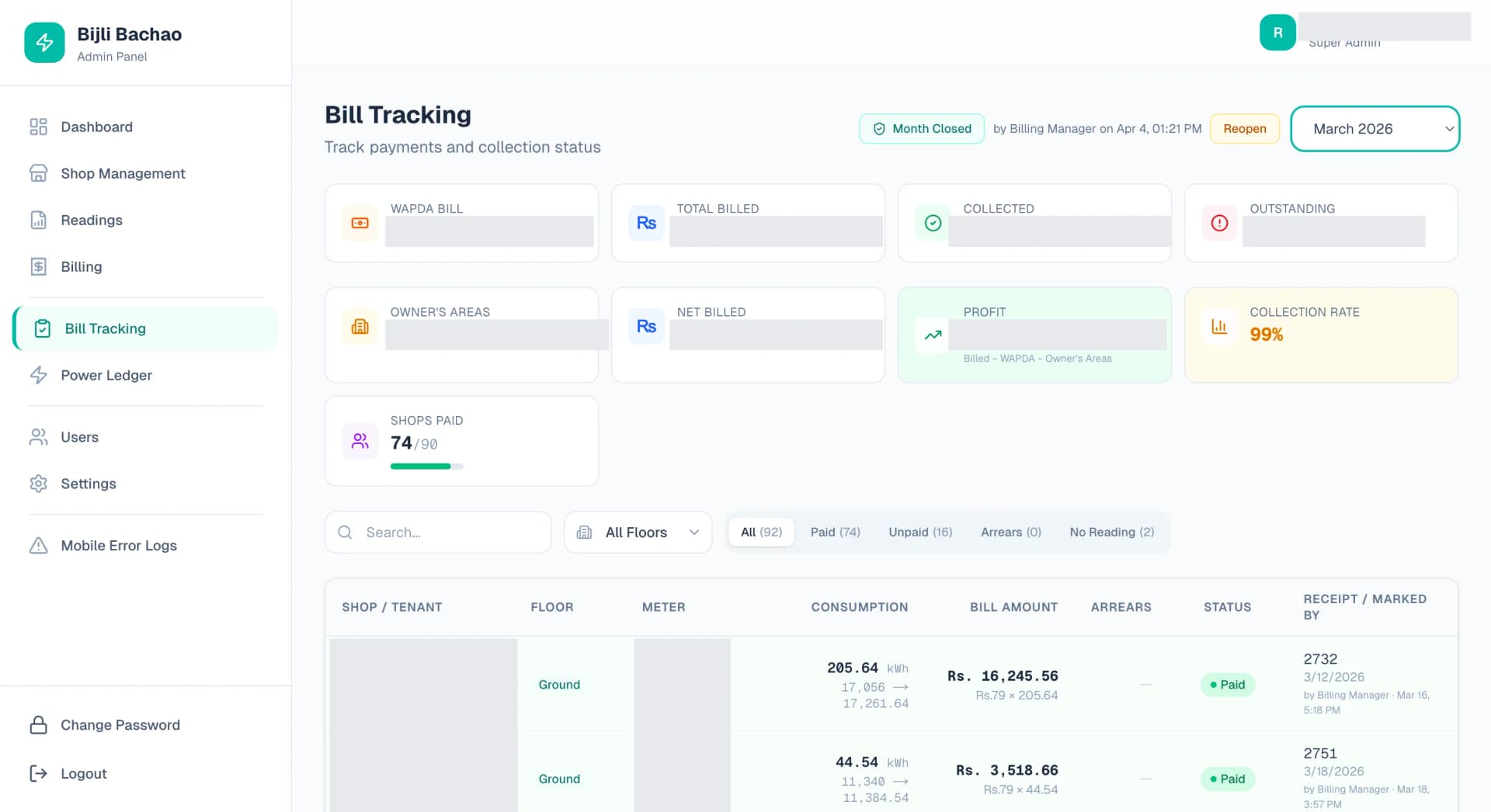
Supply, consumption and collections in one record
The ledger compares recorded supply with metered consumption. A gap prompts investigation: physical losses, unmetered loads, faulty readings or mismatched periods can all contribute. The difference alone does not establish theft or its cause.
Every other guarantee on this page makes a bill defensible. This one makes the building legible — and it is the thing the platform team names, unprompted, as the strongest screen they have.
Once a month closes, its readings, bills and payments become read-only. What everybody agreed to stays what everybody agreed to.
A closed month can be reopened, because sometimes it must be. It is recorded against a role and a time — so the correction is part of the history rather than a replacement for it.
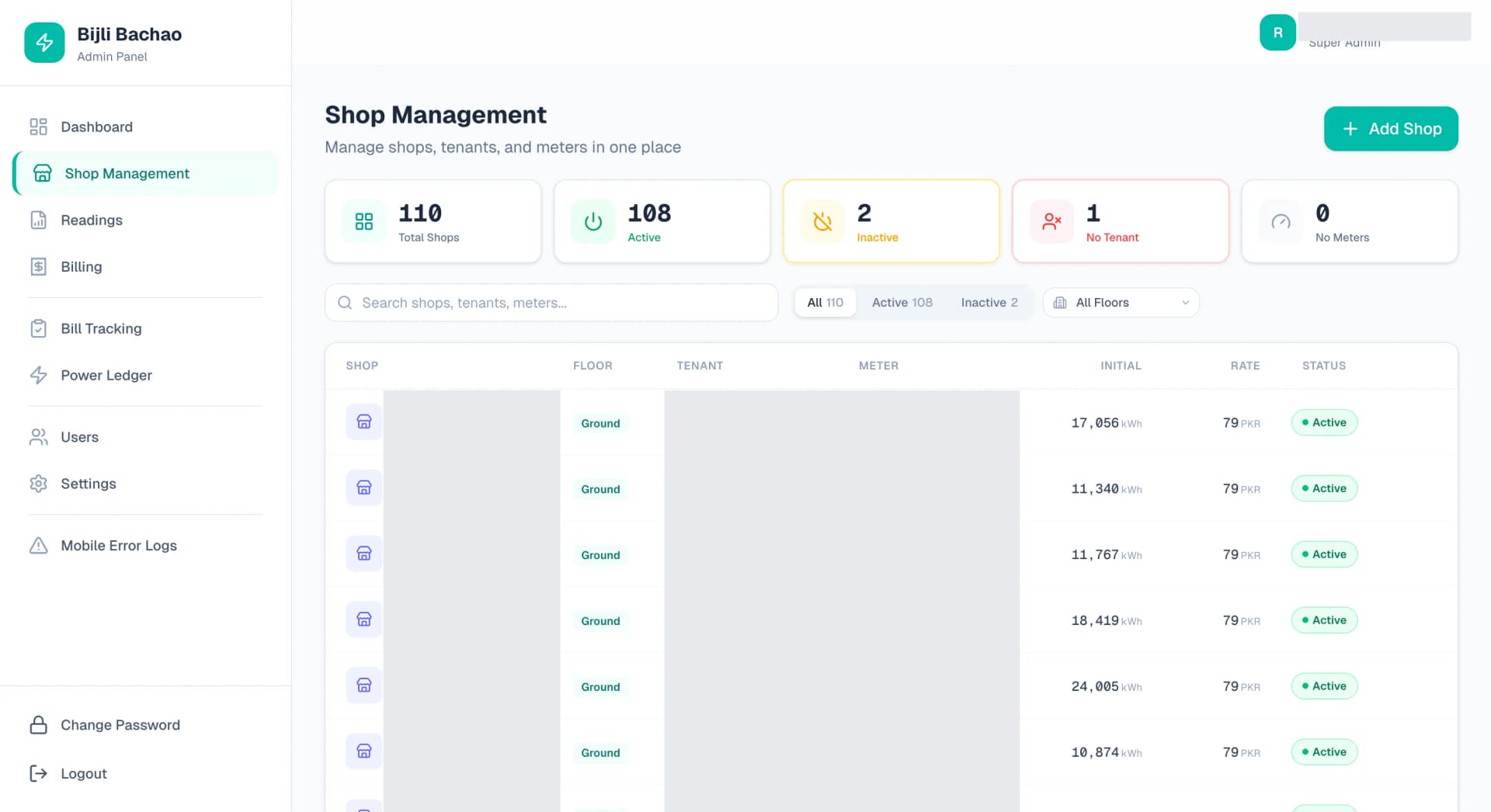
The property has ~545 units in it; 129 shops are onboarded and about111 are billed each month. The gap is not an oversight — it is the untidy remainder every schema forgets, and each state has to behave correctly before a single bill is trustworthy.
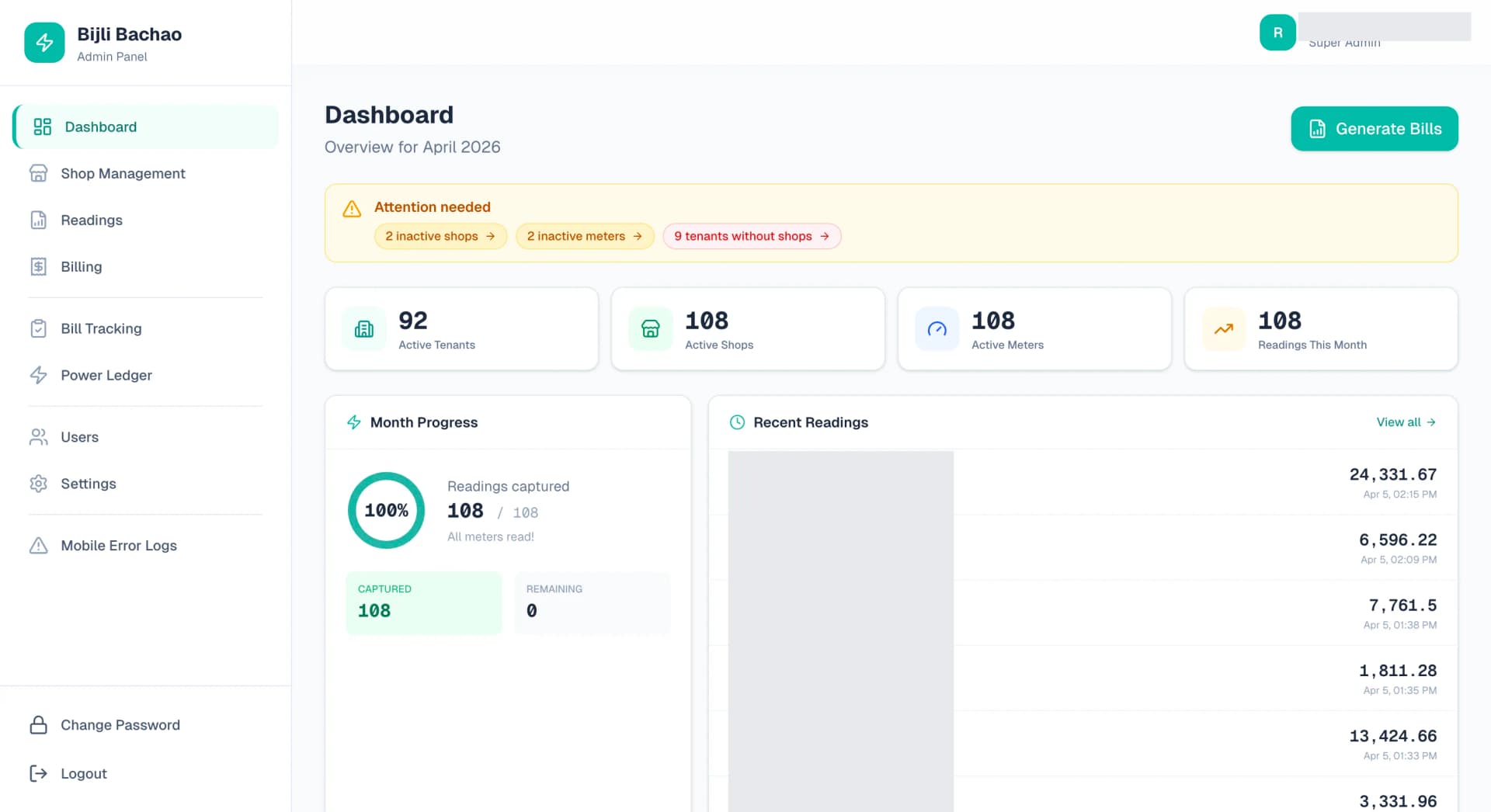
1
A unit between leases still has a meter and still accrues common-area load.
9
Registered parties not currently occupying — they must not receive a bill.
2
Excluded from billing without being deleted, so history stays intact.
An operator walks the building with a phone; a manager closes the month in a browser. The split is the point — the person who captures a reading must not be the person who approves it, and the software has to make that impossible rather than merely discouraged.
The tenant can see how the number was reached. Transparent arithmetic is what actually ends a dispute — a total on its own restarts one.
A tenant with several units gets one consolidated invoice with a line per meter — the multiplying factor applied per line, not assumed.
Access control is not an administrative detail here. It is what makes the photograph evidence instead of decoration.
Super Admin
The owner or most senior manager. Exclusively: reopen a closed month, delete a record, manage accounts, set a meter’s opening value.
Admin
Property or operations manager. Tenants, shops, meters, reading review, billing, marking paid or unpaid, closing the month.
Billing Manager
The billing desk. Rates, CT factors, billing, marking paid, closing the month — but no user management, and no undoing a payment.
Operator
Field staff. Capture readings in the mobile app; read-only on the web.
Bills derive from readings and rates. There is no field to edit, so there is nothing to fudge — a whole class of dispute, and of fraud, removed by refusing to offer the control.
An anchor tenant on a negotiated rate, an ordinary shop, and everybody else are billed correctly from one system, without a parallel spreadsheet of exceptions.
Heavy three-phase connections meter a fraction of the real current and must be multiplied up. The multiplication is shown on the tenant’s own bill, so they can check it rather than take it on trust.
Deactivating a tenant carries their shops and meters with it, and nothing is destroyed — so a property that changes shape does not lose its history.
Week 1
Set up
Shops, meters, multiplying factors and rates configured; operator and manager accounts created against them.
Week 2
Train
Operators trained on capture; managers walked through approval, billing and close.
Week 3
Go live
A real cycle run end to end on real readings, monitored throughout.
Source · Figures are a production snapshot dated 25 August 2026, corroborated by the product’s own screens. The capture app is built with React Native / Expo on Android, reading meter faces with Google Cloud Vision. Every screenshot on this page is redacted — tenant names, shop names, meter serials, the operator’s email and all monetary totals are covered.
Tenant billing and utility submetering are established property-management workflows. WattEY Metering’s case is the system Ali delivered for Mall of Mureedkay, a shopping mall in Punjab: photographic evidence, operator confirmation and a billing period that can be reconciled.
Only the shopping-mall deployment is claimed here. Other settings are potential adaptations; equivalent features, regulatory suitability and deployments are not implied.
Property submetering and utility-billing workflows.
Commercial properties and consumption-based tenant billing.
Field records that upload after connectivity returns.
These are category references, not partners, endorsements or feature-equivalence claims. Sources reviewed 13 October 2026.
BijliBachao.pk’s Solar Share System combines commercial solar delivery with tenant-level billing. WattEY Metering supplies the reading and reconciliation workflow; Solar Performance Cloud addresses the separate question of whether the solar plant is performing.
Solar Performance Cloud — the generation sideTake the meters out and what is left is a machine for capturing evidence in the field, reading it automatically without over-trusting the read, and turning it into a figure two parties who disagree can both rely on.
That problem is everywhere. It is only called sub-metering here.
A field reading arrives with the artefact that proves it — an image, timestamped and retained. The record is defensible later precisely because the proof was captured at the same instant as the value, not reconstructed afterwards.
An automated read that cannot say how sure it is will be trusted uniformly, including when it is wrong. Scoring every extraction and routing the weak ones to a human is what makes the automation safe to bill from.
Separation of duties is what converts a photograph from decoration into evidence. It is an access-control decision that determines whether the whole audit trail means anything.
A wrong value is superseded under audit rather than replaced. The mistake stays visible, which is the difference between a history and a current state pretending to be one.
A record everyone agreed to must stop moving. Freezing it — and recording any reopening against a named role — is what lets two parties rely on the same number a year later.
Field work happens in basements and dead zones. Offline capture with duplicate prevention inside the queue is not a nice-to-have; it decides whether the data exists at all.
Counting things in the field, where the count will be challenged.
Source records with photographs, review and attributed corrections.
Photographic evidence attached to an assessment that decides a payment.
Field confirmation captured offline, reconciled centrally, disputed occasionally.
Illustrative domains where the same structure occurs — not clients, not deployments.
Any spreadsheet can divide a utility bill by a list of shops. What a building manager actually lacks is the ability to prove the division — and until that exists, every month ends in an argument the landlord loses by default.
So the system was built backwards from the dispute: a photograph behind every reading, an automated read that admits its own uncertainty, an approver who is never the capturer, a correction that appends rather than erases, and a month that stops moving. The invoice falls out of that. Getting the order right is the product decision — and it is what made a rooftop sellable to the tenants underneath it.
And what it does not claim
Figures are a production snapshot dated 25 August 2026.
Questions about the delivered system, the mobile app, the evidence and the work that transfers.
The whole system: the mobile capture application, the OCR pipeline that reads a meter face and scores its own confidence, the approval workflow that separates capture from validation, the billing engine and its single published formula, the arrears and payment tracking, the reconciliation against the utility bill, and the month-close that freezes the books. He leads it as Head of Energy Systems & Product Engineering at BijliBachao.pk.
That the deliverable is not the invoice. Any spreadsheet can produce an invoice; what a building manager actually lacks is the ability to prove one. So the system was built around evidence — a photograph retained behind every reading, a formula shown to the person being billed, and a month that can be frozen — and the invoice falls out of it. Getting that ordering right is the product decision; everything downstream is ordinary engineering.
Because a reading that the same person can both take and approve is not evidence of anything. An operator in WattEY Metering can capture and nothing else — no rates, no billing, no approval — and a manager reviews each reading against its own photograph and last month’s figure, requesting an audited retake rather than editing a number silently. Without that separation the photographs would be decoration.
Because the raw captures contained real tenant names, shop trading names, meter serial numbers, the operator’s email address and, on one screen, the property owner’s monthly profit and loss. The tenants are small shopkeepers who never agreed to appear on a portfolio. The screens are shown because they are real and running; the people in them are not the evidence, and neither is the client’s margin.
Very few, and that is recent. Read-only queries against the production database on 25 August 2026 replaced the page’s earlier figures, several of which were wrong — the scale twice over, and the optical-character-recognition accuracy twice over. Four outcome percentages that had circulated in marketing material were traced to a document listing them as typical results for a hypothetical property, with no baseline and no measurement anywhere, and were dropped rather than softened. Two billing-cycle claims failed the same check and were dropped too. No speed figure is stated for the automatic reading because no timing telemetry is stored, and no offline-capture count is given because synced readings cannot be distinguished after the fact. What remains is measured.
A rooftop with a customer. Wattey Energy (formerly BijliBachao.pk) sells a service it calls Solar Share System, which is commercial solar EPC bundled with WattEY Metering: the owner installs the array and each tenant gets a photo-verified bill crediting solar units against grid units. A landlord cannot sell rooftop generation to their own tenants on the strength of a spreadsheet, because the tenants have to accept the bill. The billing layer is the precondition for that service existing, not a feature of it.
Yardi publishes property submetering and utility-billing services, and ista publishes commercial submetering for consumption-based tenant billing. These establish the problem category. WattEY Metering is Ali’s delivery for one shopping mall; these companies are not partners or endorsers, and equivalent features or deployments are not claimed.
The 25 August 2026 production snapshot documents 5 closed monthly cycles, 668 readings with photographs and 61 arrears settlements. These establish repeated use of the workflow. No measured time saving, revenue recovery or general OCR accuracy percentage is claimed.
The shape is general: field staff capturing data on a phone in places with no signal, an automated read of that capture that has to declare its own confidence, an approval path where the capturer is not the approver, a computation that has to be explainable to the person it charges, and a periodic close that makes the record immutable. That is stock audit, asset inspection and field logistics. These are potential adaptations requiring their own domain model and validation; they are not WattEY Metering deployments.
Yes. The delivered system includes a React Native / Expo Android app for operator meter capture, plus a web portal for review, billing, payments and monthly close. The app selects meters, retains photographs, supports retakes and queues readings for upload.
Cloud OCR requires connectivity because it calls Google Cloud Vision through the web application’s authenticated proxy. The app can retain a photograph and an operator-entered reading offline, then upload the queued record when connectivity returns. Offline OCR is not claimed.
WattEY Metering handles commercial shop and meter billing through monthly periods. The separate Sub-Billing case study addresses residents who move in and out mid-period. The evidence and reconciliation ideas transfer, but occupancy rules and settlement calculations require a different domain model.
Connected capture requests server time. Offline capture, or a failed server-time request, uses the device clock and retains that time with the queued reading. The case study therefore describes operational capture timestamps, not a universal guarantee against clock changes.
The database uniqueness rule applies to original readings for each meter and billing month. Retakes are exempt from that rule and are linked to the review workflow; the billing calculation chooses the applicable retake instead of adding a second bill for the same meter.
Production figures: 25 August 2026. Portal screens are redacted. The demonstration bill uses fictional names and property details, with real meter photographs.
Case study by Ali Ahmed · Head of Energy Systems & Product Engineering, Wattey Energy
Production figures: 25 August 2026. Portal screens are redacted. The demonstration bill uses fictional names and property details, with real meter photographs.