GIZ · German federal government
Safe, legal
pathways to
Germany. — Consultant — GIZ (Pakistani-German Facilitation & Reintegration Centre), December 2021 – April 2022.
Ali Ahmed created the public-information material for a German-government safe-migration programme — helping people take the legal, safe pathways to work in Germany rather than risky irregular routes. A bilateral development project aligned with the UN goal of safe, orderly migration (SDG 10.7).
Ali Ahmed created the public-information material for a German-government safe-migration programme — the Pakistani-German Facilitation & Reintegration Centre, run by GIZ with Pakistan’s overseas-employment ministry — helping people understand the legal, safe pathways to work in Germany rather than risky irregular routes. A bilateral development project aligned with the UN goal of safe, orderly migration (SDG 10.7). He worked as a Consultant, across Germany and Pakistan.

Ali Ahmed
Consultant · Pakistani-German Facilitation & Reintegration Centre (GIZ)
December 2021 – April 2022 · Concluded
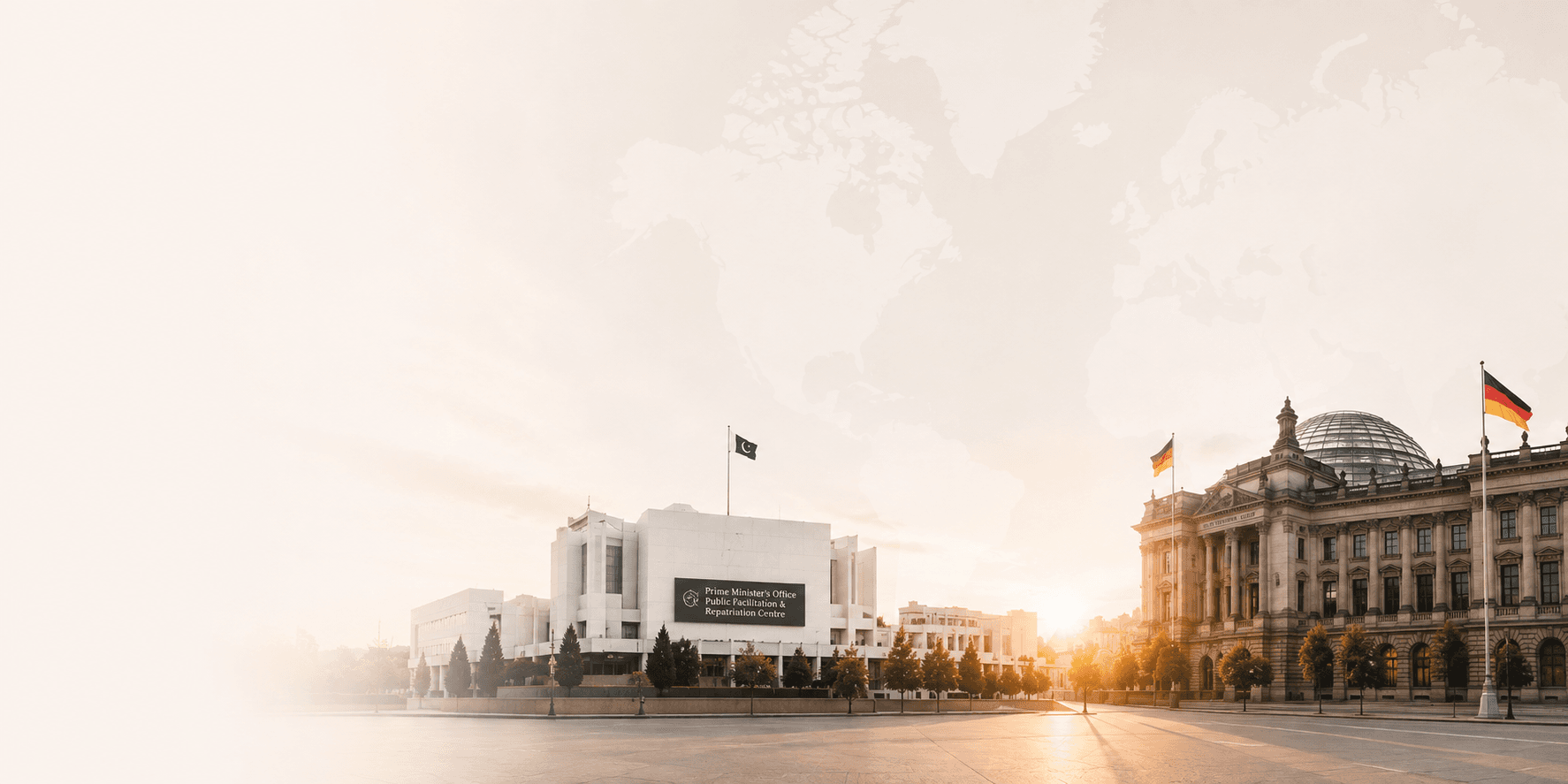
PakistanGermany
- Programme
- PGFRC
- Pakistan – Germany Facilitation & Reintegration Centre
- Bilateral cooperation
- Strengthening partnership for safe, legal and well-informed migration.
- Focus
- Safe Migration & Reintegration
- Output type
- Public Information Materials
- Initiative area
- Facilitation & Reintegration
- Duration
- December 2021 – April 2022
- GIZ
- German federal government’s development agency
- PGFRC
- Pakistani-German Facilitation & Reintegration Centre
- BMZ
- Commissioned by Germany’s development ministry (BMZ)
- SDG 10.7
- Safe, orderly and regular migration for all


01 / The Context
Migration isn’t simply
movement between places.
It’s movement
through systems.
The Pakistani-German Facilitation & Reintegration Centre (PGFRC) is a bilateral programme implemented by GIZ and funded by the German government (BMZ). It works on both sides of the journey — helping people in Pakistan access safe, regular pathways to Germany, and supporting returning overseas Pakistanis to reintegrate and rebuild at home.
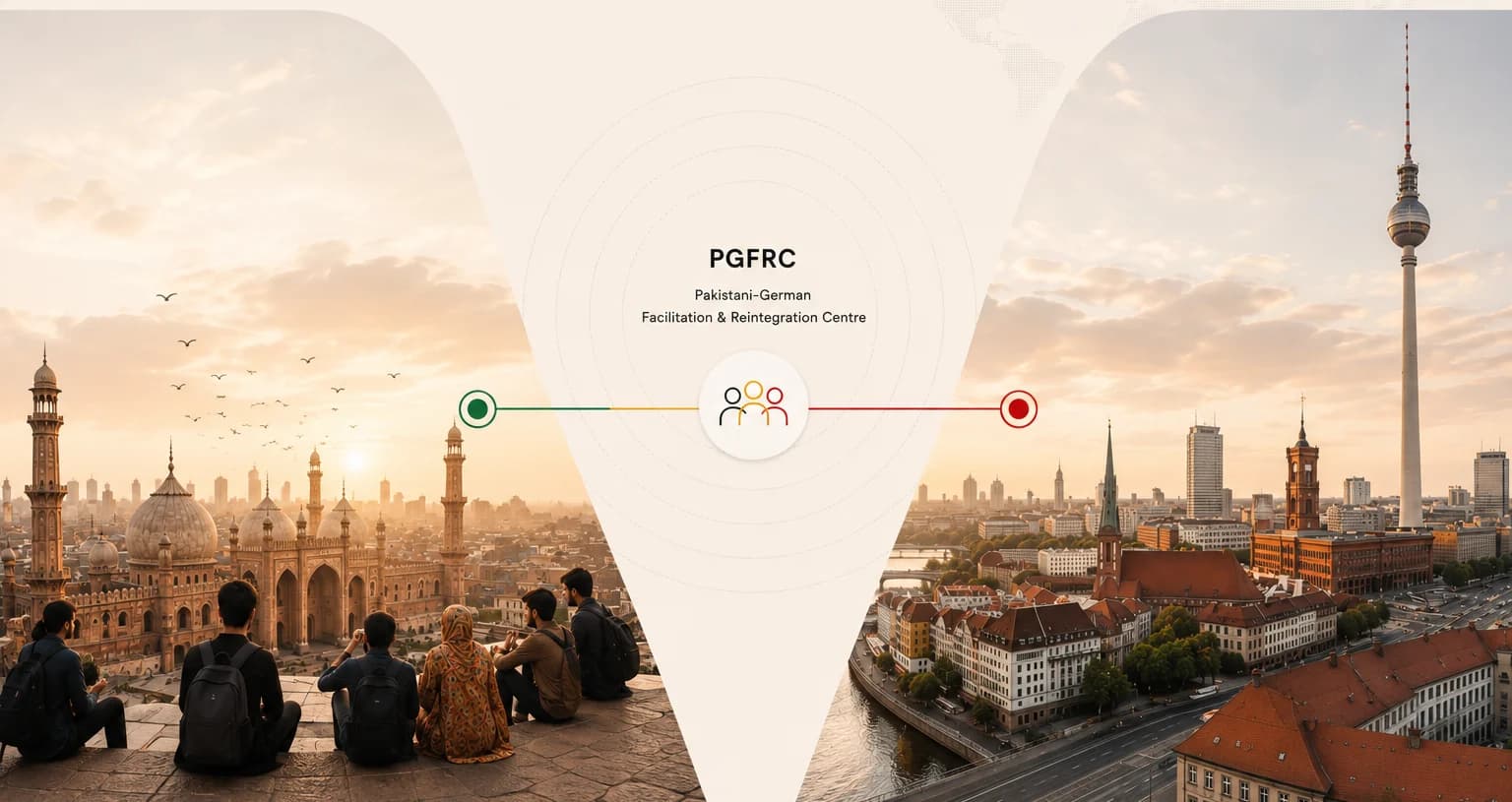
Pakistan
Facilitation
Understanding legitimate pathways, requirements and opportunities before making the journey.
PGFRC
Pakistani-German Facilitation & Reintegration Centre — the institutional bridge between the two systems.
Germany
Reintegration
Information and support for people navigating return and reintegration.
- Bilateral partnership
- Pakistan and Germany working together for safe, legal migration.
- Human-centered
- Empowering individuals to make informed, safe decisions.
- Safe & regular pathways
- Promoting legal routes and protecting people from irregular migration.
- SDG aligned
- Contributing to SDG 10.7 — safe, orderly and regular migration.
PGFRC means the Pakistani-German Facilitation & Reintegration Centre — a bilateral GIZ programme, funded by the German government (BMZ), that connects Pakistan and Germany. It provides facilitation (information on safe, regular pathways to work in Germany) and reintegration (support for returning overseas Pakistanis). This is the programme context; Ali Ahmed’s specific contribution — the public-information material — is described in the following section. Ali Ahmed did not found or operate PGFRC and did not lead the programme.

02 / What Ali contributed
Turning a complex public pathway into information people could use.
Working to GIZ’s institutional branding guidelines and reporting to the programme advisor, Ali developed the public-information and branding material that makes the legal migration pathway understandable — so people take the safe, regular route instead of a dangerous irregular one. He translated the essential steps into clear infographics and illustrations, and ran the desk research behind them.
- 01Recognitionof qualification
Understanding and evaluating educational and professional qualifications.
- 02Germanlanguage
Learning German to the required level for study or employment opportunities.
- 03Jobsearch
Finding suitable employment opportunities that match skills and qualifications.
- 04Visa
Applying for a legal visa and completing the required procedures.
- Germany
The safe, legal destination the pathway leads to.
- Desk research
- Researched requirements, procedures and sources to understand the full pathway.
- Information design
- Structured complex information into clear, logical and easy-to-follow communication.
- Infographics & illustration
- Created infographics and illustrations that communicate the pathway in a simple and visual way.
Confidentiality / 01
The work isn’t shown. The thinking is.
The deliverables and materials created as part of this assignment are the property of GIZ. Under our confidentiality agreement, they cannot be published or shared. This page reflects the nature of the work in general terms only.
Ali Ahmed contributed the public-information and branding material for the GIZ safe-migration programme: desk research, information design, and infographics and illustrations that made the legal migration pathway to Germany understandable — recognition of qualifications, German language, job search and the visa process. The deliverables remain confidential to GIZ and are not shown.
03 / Institutional practice
Institutional trust.
Means knowing
what not to publish.
Many of the public-information materials, research outputs and visual assets created during this engagement remain the intellectual property of the programme and are therefore not reproduced here.
“Good consulting isn’t measured by what can be shown. It’s measured by what can be trusted.”

- Research
- Understanding policy, procedures and pathways.
- Information design
- Turning complex institutional information into clarity.
- Institutional review
- Working through approval, governance and compliance.
Institutional trust: much of the public-information material, research and visual assets Ali Ahmed created for the GIZ programme remain the intellectual property of the programme and are not reproduced here. His contribution spanned research (understanding policy, procedures and pathways), information design (turning complex institutional information into clear public communication) and institutional review (working through governance, approvals and compliance).
04 / Questions
Questions, answered.
What is GIZ?
GIZ — Deutsche Gesellschaft für Internationale Zusammenarbeit — is the German federal government’s international development agency: a federal enterprise commissioned chiefly by the Federal Ministry for Economic Cooperation and Development (BMZ), operating in more than 130 countries.
What is the Pakistani-German Facilitation & Reintegration Centre (PGFRC)?
A joint institution set up by Pakistan’s Ministry of Overseas Pakistanis & HRD, implemented by GIZ and funded by the German government (BMZ). It advises people on regular, safe pathways to work or study in Germany, and helps returning overseas Pakistanis reintegrate — part of GIZ’s wider migration-and-development work.
What was Ali Ahmed’s role at GIZ?
He was a Consultant on the PGFRC programme (December 2021 – April 2022), creating the public-information and branding material on the legal, safe pathways to work in Germany. He was contracted to the programme — not employed by GIZ — and the engagement ran concurrently with his role at Innovation District 92.
How does this align with the UN Sustainable Development Goals?
The programme advances SDG 10.7 — the target to “facilitate orderly, safe, regular and responsible migration.” Ali’s information material supports exactly that: helping people choose the legal, safe route over dangerous irregular migration. It sits alongside his CIRCLE × Gates Foundation chapter (SDG 5, 8 and 4) as his development-sector record.
Did Ali Ahmed work directly with the Pakistani federal ministries?
No. The Ministry of Overseas Pakistanis & HRD, Overseas Pakistanis Foundation, Overseas Employment Corporation, Federal Investigation Agency and Bureau of Emigration are the programme’s institutional counterparts — its stakeholder map. Ali worked on the programme’s information material and reported to its advisor, not to those bodies directly.
Can Ali Ahmed show the material he produced for GIZ?
No — and that is by design. The deliverables are GIZ’s property under a confidentiality agreement, so they are not reproduced here. This chapter carries the engagement and its mission, not the work product. Respecting client confidentiality is part of how the work was done.
How does this connect to Ali Ahmed’s other work?
It is the German-federal-government half of his institutional record: alongside the CIRCLE × Gates Foundation chapter, it shows he has operated inside the bilateral-development world — with international agencies and governments — not only with startups and companies.