A bill is only worth what it can survive.
One utility connection, ~545 units behind it, and a shopkeeper every month who says the reading is wrong. Ali built the layer that settles it — and it is why that property can sell its own rooftop solar to the shops underneath.
- 5
- consecutive cycles closed
- 668
- readings captured
- 100%
- carry a photograph
- 1
- formula, published
 Ali AhmedHead of Energy Systems & Product Engineering · BijliBachao.pkFigures as of 25 August 2026 · client not named
The reading
17,261.64
kWh · previous 17,056
image kept- Capturedwith the meter photographed
- ReadOCR proposes · a person confirms
- Approvedby someone who did not capture it
- Billedone formula, shown to the tenant
- Frozenand the month freezes
Built at
BijliBachao.pk
an engineering design house that builds its own software rather than buying it
In production
A live property
a ~545-unit property, with 129 shops onboarded and ~111 active meters billed monthly · since 5 March 2026
What it unlocked
Solar Share System
first in Pakistan, per BijliBachao’s own service catalogue — solar EPC sold on the strength of a bill nobody disputes
From an argument nobody could settle to a rooftop somebody could sell.
- 01
A man walked the building with a notebook. Someone retyped it into a spreadsheet nobody could audit. Once a month a shopkeeper said the reading was wrong, and there was no proof either way.
Started
0proof behind a reading
- 02
A mobile app that walks the property floor by floor, photographs every meter face and reads the digits off the image — then hands the number to an operator to confirm, because billing accuracy should not depend on a model being right.
Built
668readings · every one photographed
- 03
One published formula, computed identically for every shop and shown to the party being charged. Common area held apart, solar credited, arrears carried forward.
Delivered
1formula, shown to both sides
- 04
A whole property closing every month into a frozen, read-only ledger — with the rule that nobody gets billed twice enforced by the database rather than by the application.
Scaled
5consecutive cycles closed
- 05
A rooftop became sellable. With a bill the tenants accept, the owner can credit solar units against grid units — and BijliBachao sells that as a service it calls a Pakistan first.
Outcome
1service line, made possible
Five things break, and only one of them is the invoice.
A Pakistani mall buys electricity in bulk on one connection and has to recover it from hundreds of shops. The utility does not do that for them — sub-billing is the owner’s problem, and almost everywhere it is done by hand. These are the five failures that follow, as the platform team lists them from the field rather than from imagination.
- 01
Manual reading errors
Someone walks the building writing numbers into a register. Transposed digits and skipped meters cost real money every month, and are found only when a tenant complains.
- 02
Disputes with no evidence
A tenant says the bill is too high. The owner has a handwritten number and nothing else. Arguments drag, payments stall, relationships sour.
- 03
Slow, late billing
Walking a property of this size by hand takes a full working day; typing the numbers up and computing bills takes days more. Bills go out late, so money comes in late.
- 04
Invisible line loss
The gap between what the utility supplied and what the shop meters recorded — theft, faulty meters, un-metered load — was simply unknown. Owners absorbed it blindly.
The one nobody sees coming.
- 05
History that can be rewritten
In spreadsheet billing, fixing a rate or a tenant record silently corrupts every past month. No ledger, no audit trail, no answer to who changed what.
What TenantBill changed
- Every reading carries a photograph, timestamped by the server and kept.
- The bill computes the same way for every shop — and the billing page has no editable field.
- Solar credit and common-area load are held apart and never charged back to a shop.
- The month closes into a frozen ledger, and line loss finally has a number on it.
The deliverable was never the invoice. It was the evidence behind it.
And the positioning falls out of the same observation, in the platform team’s own words: sub-metering hardware exists and utility software exists, but nothing served the owner in the middle who buys bulk and re-bills retail.
01The hard part
A photograph is not proof.
A chain is.
Attaching a picture to a meter reading is the easy idea, and it is where most photo-verified billing stops. It does not survive a real dispute — because a photograph taken and approved by the same person proves nothing that a handwritten number did not already prove.
The conversation the software has to win
- “That is not my reading.”
- Here is the photograph of your meter, with the time it was taken.
- “Someone typed it wrong.”
- Nobody typed it. The camera read it off the meter and an operator confirmed it against the photograph.
- “Your man could have made it up.”
- He cannot approve his own capture. Someone else did, against the image.
- “You changed it afterwards.”
- The bill froze when it was paid. A later rate change cannot reach back into it.
Eight properties · remove one and the rest stop meaning anything
- 01
Photographic evidence, permanently attached
Every reading stores its photograph and timestamp, and the photograph appears both in the dashboard and on the printed bill. There is no "trust me" anywhere in the chain.
Without it, the reading is one person’s word.
- 02
Timestamps the phone cannot set
Reading times come from the server, not from a handset whose clock may be wrong — or deliberately adjusted. The evidence carries a time nobody in the field controls.
Without it, a handset with a wrong clock decides when the evidence happened.
- 03
Immutable snapshots
The moment a bill is paid, and again when the month closes, the whole bill freezes — readings, rate, factor, tax, tenant, shop, floor. Changing a rate or renaming a tenant later can never rewrite a past bill.
Without it, changing a rate today silently rewrites what somebody was charged last year.
- 04
Soft deletes only
Ledger records are never physically destroyed. A "deleted" record is flagged, attributed and recoverable, so a deletion is part of the history rather than a hole in it.
Without it, a deletion is a hole in the history rather than part of it.
- 05
Triple-guarded reversal
Reopening a closed month asks for confirmation, is re-checked by the application, and is blocked outright at the database whenever it could bill a tenant twice for the same month.
Without it, an honest correction can bill a tenant twice for the same month.
- 06
Invariants the application cannot bypass
One reading per meter per month, and no new readings until last month is closed — both enforced by the database itself. Not by the phone, not by the API, not by a policy. A misbehaving handset, a stale app version and a determined user all fail the same way.
Without it, one stale app version is all it takes to break the rule everywhere.
- 07
Every action carries a name
Months record who closed them, payments record who marked them, deactivations and deletions record the actor. "Who did this?" is answered by the record rather than by argument.
Without it, “who did this?” is settled by argument.
- 08
Powers split along the money
Only the most senior role can reopen a month, delete a reading, or set a meter’s opening value. Billing staff can record money coming in but cannot quietly reverse a payment — that needs a level above them.
Without it, the person who records the money can also make it disappear.
Not a diagram — the shipped product
Two of the five links are visible on one screen. Every row carries a confidence score beside its reading, and the action available on a bad one is Request Retake — not edit.
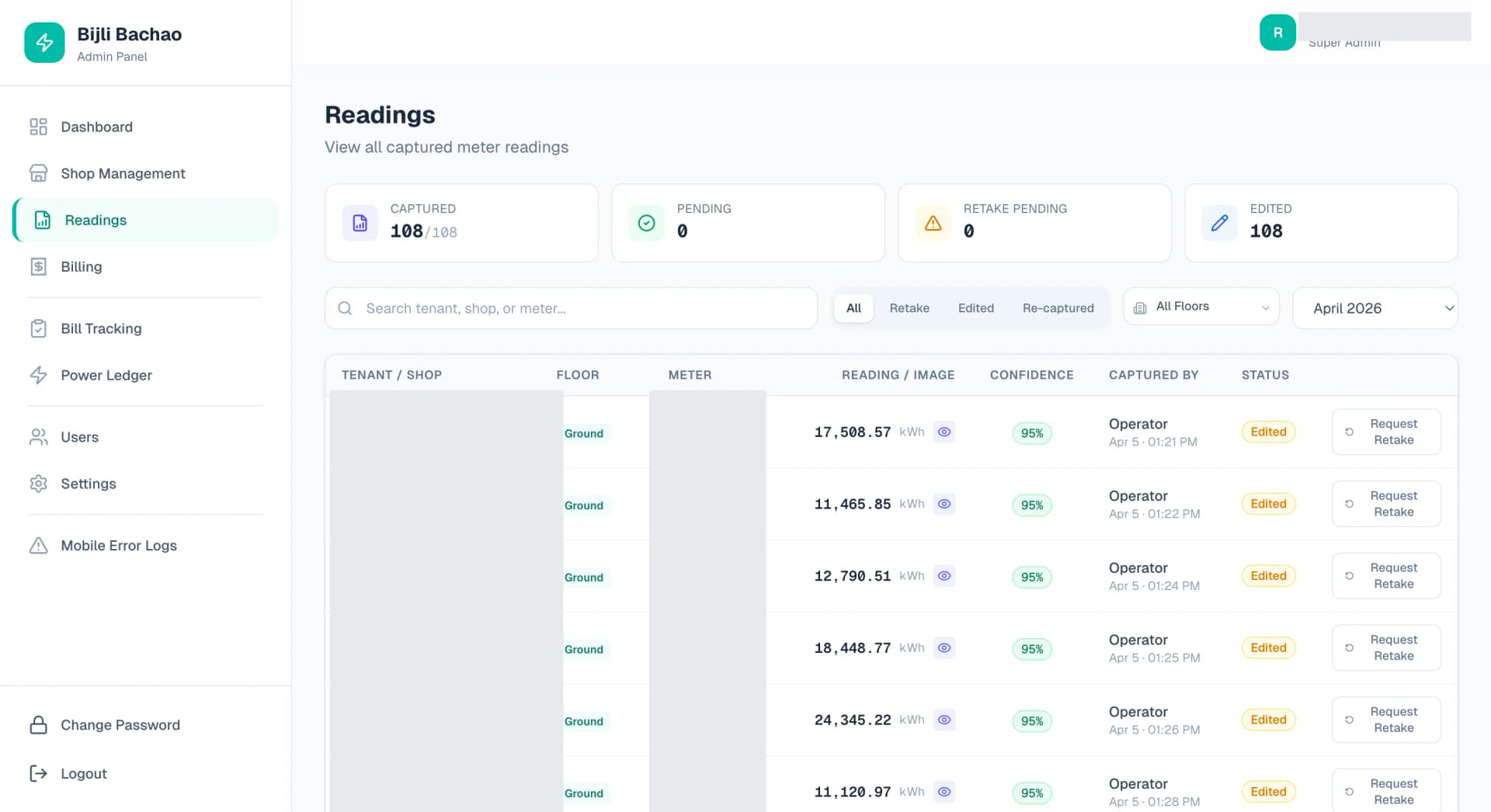
The machine reads, the human confirms
The camera proposes a value, a person confirms it against the photograph, and the photograph stays attached to the bill. Of 668 readings ever captured, 667 carry the operator’s confirmation and 668 carry an image — the system has never billed an unreviewed guess.
Retake, never overwrite
A disputed or unreadable capture is re-photographed under audit. The original stays in the record, so a correction is visible as a correction.
Offline is the normal case
Signal-dead corridors are expected, so the app captures without a network and syncs later. Because extraction runs through that proxy it needs connectivity; a capture taken offline still photographs the meter and defers the reading to operator entry. One reading per meter per month holds regardless — a unique index in the database means a replayed sync physically cannot double-insert.
Where the chain ends
The evidence leaves the building on the bill itself.
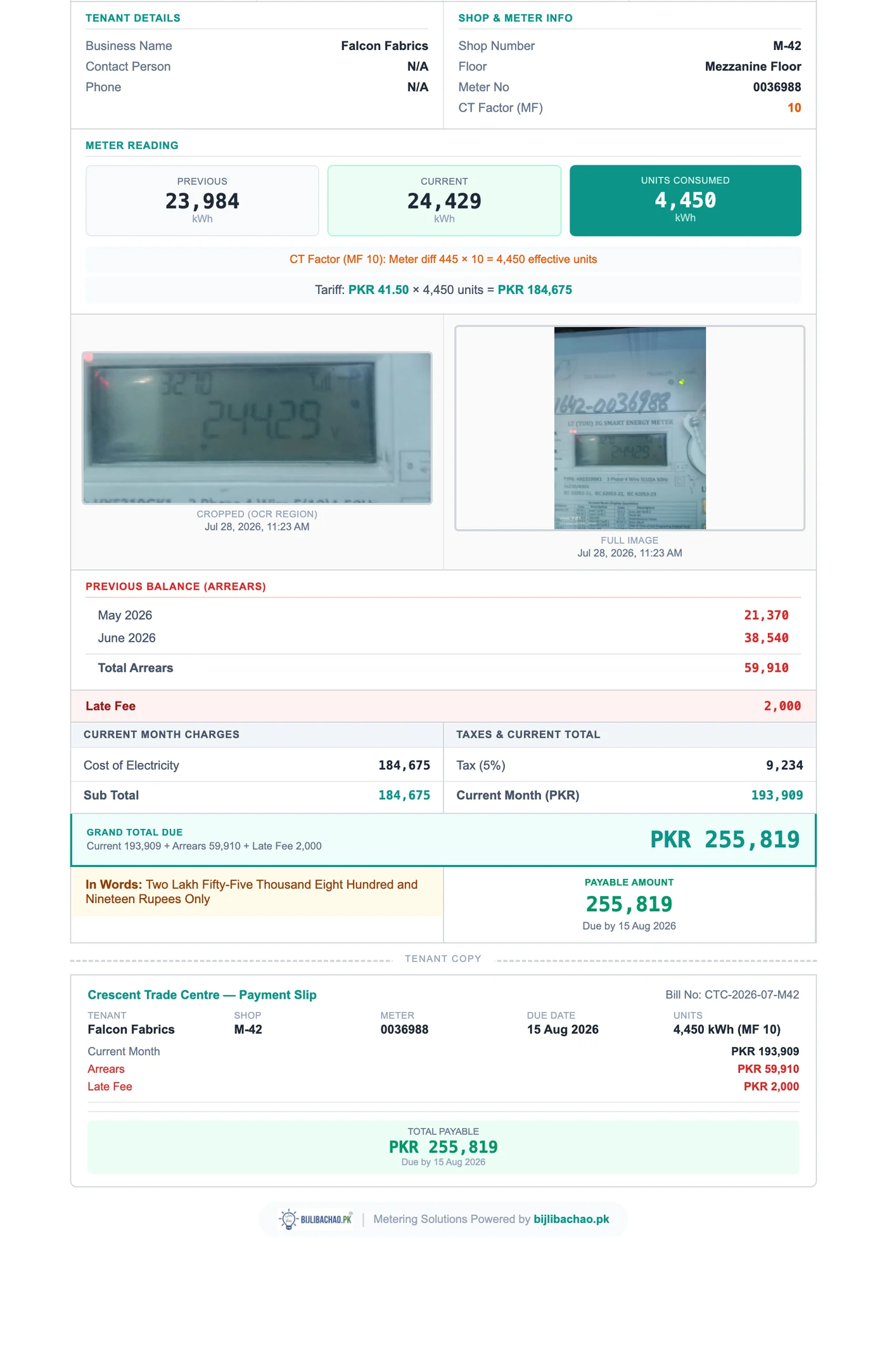
The proof travels with the charge
Two photographs of the meter are printed on the bill — the cropped display and the full face, both timestamped. A tenant disputing the figure is not asked to trust a database; they are holding the picture.
The LCD reads 24429. The bill says 24,429.
Look at the photograph and then at the reading. That correspondence is the entire argument of this chapter, and it is checkable on the paper by the person being billed.
The factor arithmetic is shown, not applied silently
A CT-metered connection reads a fraction of the real current and must be multiplied up. The bill prints “meter difference 445 × 10 = 4,450 effective units” — so the step most likely to be disputed is the step most visibly worked out.
Arrears arrive as a statement, not a surprise
Two carried months and the late fee are itemised above the current charge, and the grand total shows its own components. Nothing about the number requires an explanation over a counter.
The bill was never the product. The product was making the bill impossible to argue with.
Any spreadsheet can produce an invoice. Almost none can defend one.
02The month has to close
Four numbers that have to tie.
“The numbers never quite add up” is not a complaint about arithmetic. It is that the tenant invoices and the utility bill describe two different worlds, and the gap between them is the owner’s loss with no name on it. Reconciling the four quantities is what turns billing software into a book of account.
One property · March 2026
Solar is credited against building consumption without being counted twice, and shared lighting and lifts are billed to the building rather than back to a shop. No rupee figure from this property is published anywhere on this page.
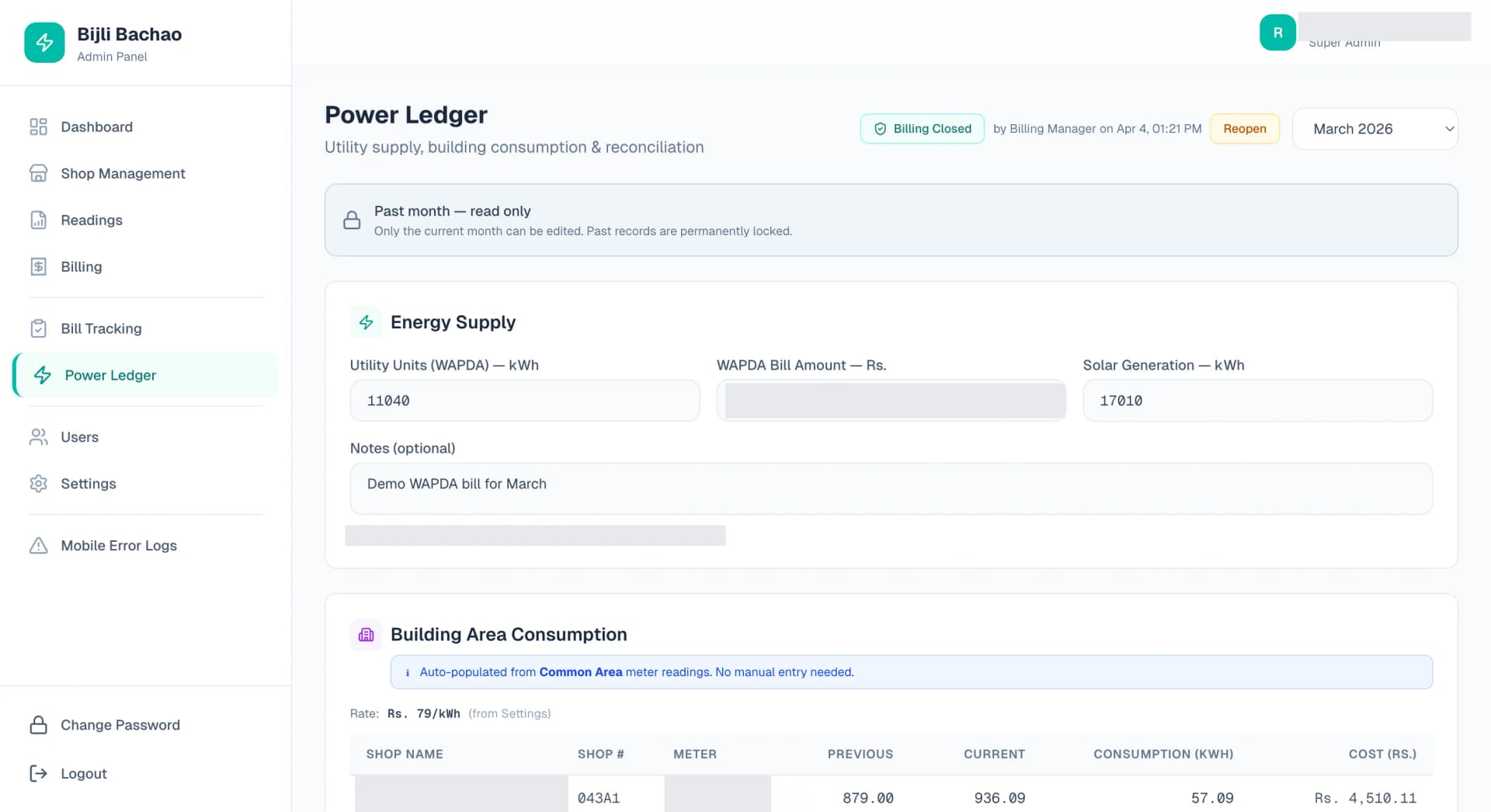
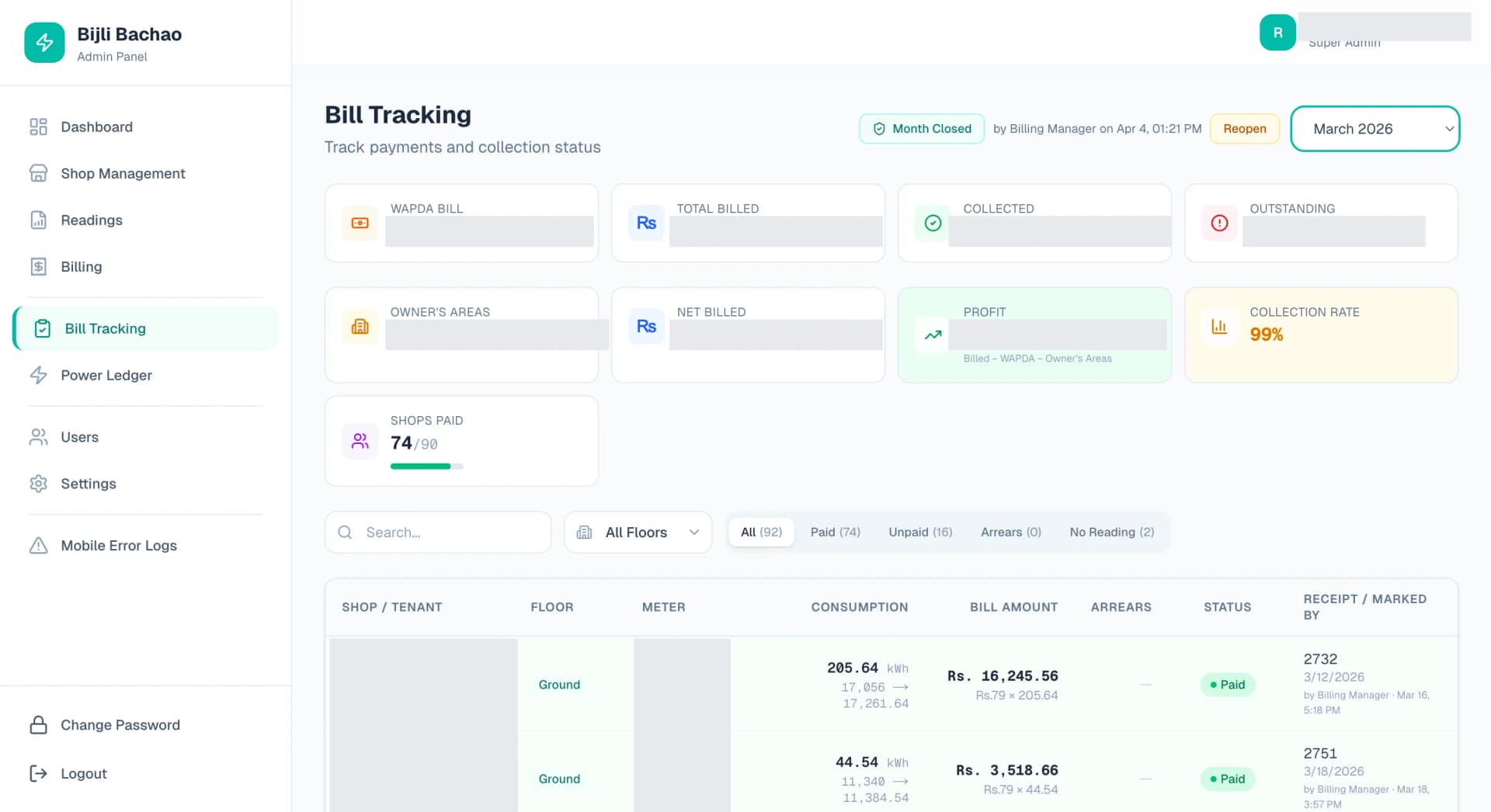
The question a spreadsheet cannot ask
Where did the electricity go that nobody paid for?
The energy that entered the building and was never billed to anyone — theft, a failing meter, an un-metered load. On spreadsheets it cannot be computed at all, so the owner absorbs it without knowing it is there.
Every other guarantee on this page makes a bill defensible. This one makes the building legible — and it is the thing the platform team names, unprompted, as the strongest screen they have.
- What came in?
- Utility units plus rooftop solar
- What did the shops use?
- Total metered tenant consumption
- What did the owner’s own areas use?
- Common-area load, charged to the owner and never to tenants
- What leaked?
- Line loss — supply minus metered, colour-graded
- What was billed against collected?
- Billing total against actual receipts
- Did the building make money?
- Net recovery against the utility bill — profit, and recovery percentage
Closing freezes the figures
Once a month closes, its readings, bills and payments become read-only. What everybody agreed to stays what everybody agreed to.
Reopening is an act, not a loophole
A closed month can be reopened, because sometimes it must be. It is recorded against a role and a time — so the correction is part of the history rather than a replacement for it.
A real property is never tidy — and that is where naive billing breaks.
The property has ~545 units in it; 129 shops are onboarded and about111 are billed each month. The gap is not an oversight — it is the untidy remainder every schema forgets, and each state has to behave correctly before a single bill is trustworthy.
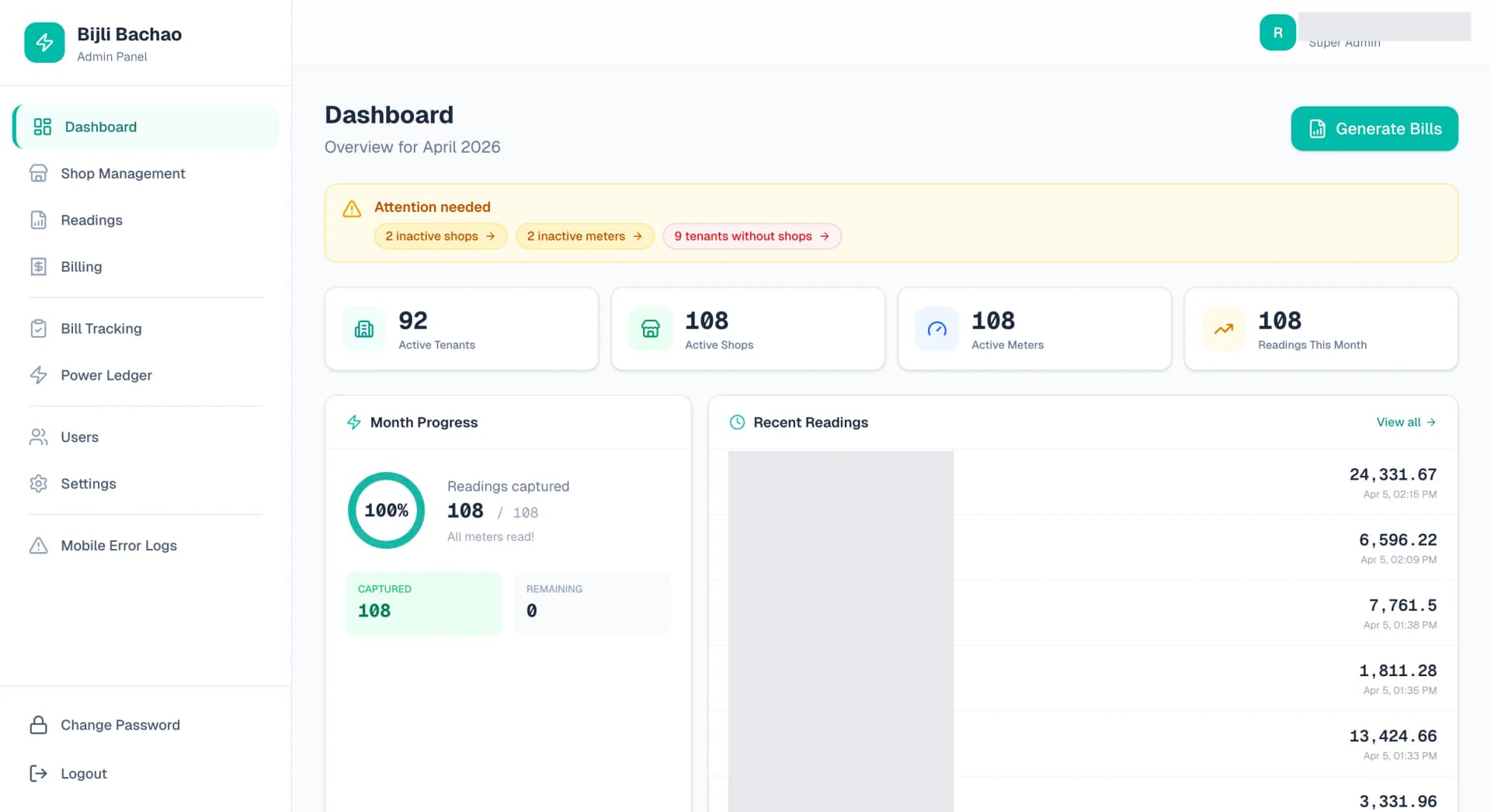
- 1
- Shops with no tenant
- 9
- Tenants with no shop
- 2
- Inactive shops
A unit between leases still has a meter and still accrues common-area load.
Registered parties not currently occupying — they must not receive a bill.
Excluded from billing without being deleted, so history stays intact.
The floor and the office, on one set of records.
An operator walks the building with a phone; a manager closes the month in a browser. The split is the point — the person who captures a reading must not be the person who approves it, and the software has to make that impossible rather than merely discouraged.
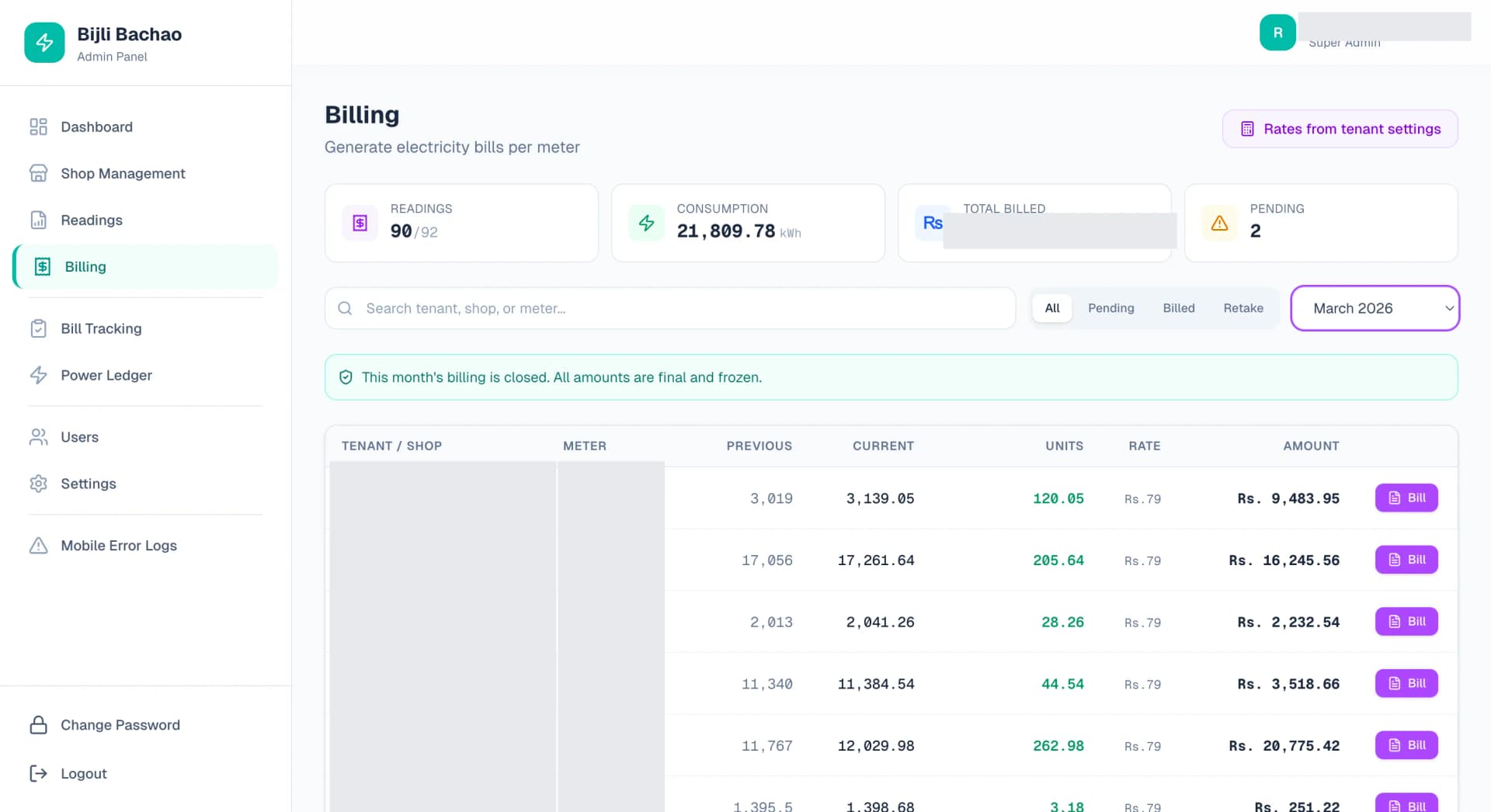
One formula, published
The tenant can see how the number was reached. Transparent arithmetic is what actually ends a dispute — a total on its own restarts one.
- Units
- (this reading − last reading) × meter factor
- Amount
- units × rate — the shop’s own, the tenant’s, or the property default
- Total
- amount + tax + arrears + late fee
A tenant with several units gets one consolidated invoice with a line per meter — the multiplying factor applied per line, not assumed.
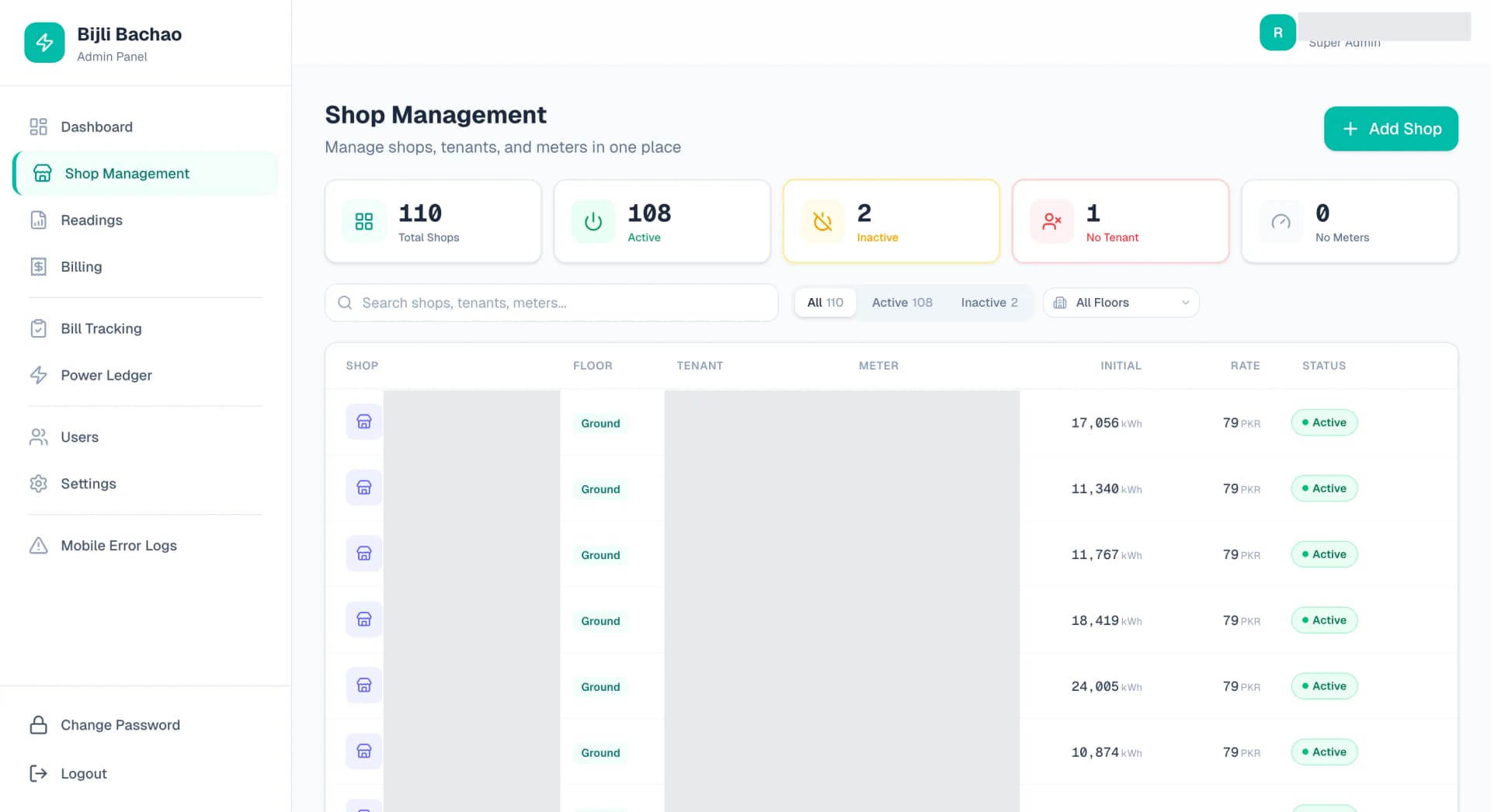
Four roles, and the gaps between them
Access control is not an administrative detail here. It is what makes the photograph evidence instead of decoration.
Super Admin
The owner or most senior manager. Exclusively: reopen a closed month, delete a record, manage accounts, set a meter’s opening value.
Admin
Property or operations manager. Tenants, shops, meters, reading review, billing, marking paid or unpaid, closing the month.
Billing Manager
The billing desk. Rates, CT factors, billing, marking paid, closing the month — but no user management, and no undoing a payment.
Operator
Field staff. Capture readings in the mobile app; read-only on the web.
Four decisions, each one removing a class of error
The billing page is read-only by design
Bills derive from readings and rates. There is no field to edit, so there is nothing to fudge — a whole class of dispute, and of fraud, removed by refusing to offer the control.
Rates resolve shop → tenant → property
An anchor tenant on a negotiated rate, an ordinary shop, and everybody else are billed correctly from one system, without a parallel spreadsheet of exceptions.
CT factor arithmetic prints on the bill
Heavy three-phase connections meter a fraction of the real current and must be multiplied up. The multiplication is shown on the tenant’s own bill, so they can check it rather than take it on trust.
Deactivation cascades, and is always soft
Deactivating a tenant carries their shops and meters with it, and nothing is destroyed — so a property that changes shape does not lose its history.
Three weeks, contract to live cycle
Week 1
Set up
Shops, meters, multiplying factors and rates configured; operator and manager accounts created against them.
Week 2
Train
Operators trained on capture; managers walked through approval, billing and close.
Week 3
Go live
A real cycle run end to end on real readings, monitored throughout.
Source · Figures are a production snapshot dated 25 August 2026, corroborated by the product’s own screens. The capture app is built with React Native / Expo on Android, reading meter faces with Google Cloud Vision. Every screenshot on this page is redacted — tenant names, shop names, meter serials, the operator’s email and all monetary totals are covered.
03Where this sits, and what it unlocked
A small, fast category inside a very large one.
Meters are a multi-billion-dollar hardware market. The software that turns their readings into bills nobody disputes is a fraction of that — and it is the part that is hard. That asymmetry is the whole argument: anyone can sell you a meter.
- $455–460M
- tenant billing software — the exact category
- 8–9%
- compound annual growth
- ~$3.8B
- the sub-metering solutions layer it sits inside
2025 · Mordor Intelligence and 360iResearch, independently within ~1%
to roughly $677M by 2030 on the same two models
2025 · growing 8.3% to $6.7B by 2032
The part that is hard to arrange
Asia-Pacific is the fastest-growing region for this category — and the named driver of its commercial segment is tenant billing needs.
- 7.8%
- Asia-Pacific growth to 2032 — the fastest of any region
- 28.4%
- share held by commercial buildings, driven by tenant billing
Ali did not build this in a market that is about to matter. He built it in the fastest-growing region for the exact category, against the exact driver the analysts name — and he did it in one of the hardest energy environments on earth.
What manual billing costs
3–8%
of a building’s total energy cost leaks in manually billed properties — reading gaps, calculation errors, and tenants underpaying without ever being challenged.
Industry-vendor estimate (EnSmart Controls), not independent research — the source sells billing software. Directional, and quoted with that attached.
Which is exactly the gap TenantBill closes
The same source names the causes: manual reading introduces human error, spreadsheets miss edge cases, and when a tenant challenges a bill there is no timestamped, tamper-proof record to show them. It also names common-area energy as the single biggest source of disputes.
Read that list against this chapter and it is a specification for the product Ali built: a photograph behind every reading, the untidy states handled explicitly rather than ignored, one formula shown to the party being charged, and common area held apart by design so it never lands on a shop’s bill.
And it is the reason a rooftop became sellable.
BijliBachao sells a service it calls Solar Share System — first in Pakistan, per BijliBachao’s own service catalogue. It is commercial solar EPC bundled with TenantBill: the owner installs the array, and every tenant gets a photo-verified bill that credits solar units against grid units. Read the dependency in that sentence and the argument is finished.
01
A rooftop
A mall roof is the largest unused asset the owner has.
02
needs a buyer
The tenants below it are the only natural customers for that generation.
03
who needs a bill they accept
Selling units to a tenant means charging them — and a charge they dispute is worse than no sale.
04
which needs evidence
A photo behind every reading, one formula shown to both sides, a month that freezes.
Without a bill the tenants accept, the roof stays a roof. Ali built the layer that turns it into an asset with a customer.
Where the identical structure exists
One connection, many parties behind it, and somebody in the middle who has to divide a bill and be believed. That shape does not care what kind of building it is in.
Shopping malls & plazas
One utility connection, dozens of retail units, a landlord in the middle.
Commercial buildings
Multi-floor offices sub-metered per floor or per suite, with shared services.
Industrial estates
A shared main connection feeding many independent units on one site.
Housing societies
Shared utility infrastructure billed onward to residents who compare notes.
A map of where the problem occurs — not places TenantBill is deployed. It runs on one property, and this page never implies otherwise.
Sources · Market figures from Mordor Intelligence, 360iResearch, Research and Markets and Persistence Market Research, 2025. The leakage range is an industry-vendor estimate and is labelled as one above. Every figure, its confidence grade and what was searched for and not found is recorded in docs/research/tenantbill-market.md. No Pakistan-specific market size is claimed, because none was found. Property figures are a 25 August 2026 snapshot of one deployment.
The electricity is incidental. The chain of custody is the product.
Take the meters out and what is left is a machine for capturing evidence in the field, reading it automatically without over-trusting the read, and turning it into a figure two parties who disagree can both rely on.
That problem is everywhere. It is only called sub-metering here.
- 01
Capture evidence, not just data
A field reading arrives with the artefact that proves it — an image, timestamped and retained. The record is defensible later precisely because the proof was captured at the same instant as the value, not reconstructed afterwards.
- 02
Make the automation declare its confidence
An automated read that cannot say how sure it is will be trusted uniformly, including when it is wrong. Scoring every extraction and routing the weak ones to a human is what makes the automation safe to bill from.
- 03
Never let one hand both capture and approve
Separation of duties is what converts a photograph from decoration into evidence. It is an access-control decision that determines whether the whole audit trail means anything.
- 04
Correct by appending, never by overwriting
A wrong value is superseded under audit rather than replaced. The mistake stays visible, which is the difference between a history and a current state pretending to be one.
- 05
Close the period, and make reopening an act
A record everyone agreed to must stop moving. Freezing it — and recording any reopening against a named role — is what lets two parties rely on the same number a year later.
- 06
Assume no signal
Field work happens in basements and dead zones. Offline capture with duplicate prevention inside the queue is not a nice-to-have; it decides whether the data exists at all.
The same system, different subject
Stock and asset audit
Counting things in the field, where the count will be challenged.
Clinical data capture
Source data with provenance, correction trails and locked periods.
Insurance inspection
Photographic evidence attached to an assessment that decides a payment.
Proof of delivery
Field confirmation captured offline, reconciled centrally, disputed occasionally.
Illustrative domains where the same structure occurs — not clients, not deployments.
The invoice was the easy part. Being believed was the product.
Any spreadsheet can divide a utility bill by a list of shops. What a building manager actually lacks is the ability to prove the division — and until that exists, every month ends in an argument the landlord loses by default.
So the system was built backwards from the dispute: a photograph behind every reading, an automated read that admits its own uncertainty, an approver who is never the capturer, a correction that appends rather than erases, and a month that stops moving. The invoice falls out of that. Getting the order right is the product decision — and it is what made a rooftop sellable to the tenants underneath it.
And what it does not claim
- It runs on one property. Everything on this page describes a single deployment, and the page never implies a portfolio.
- The scale figures are an April 2026 snapshot corroborated by the product’s own screens — not a live read, and not reconciled with the summary published on this site’s Bijli Bachao chapter.
- No client is named, no rupee figure from the deployment is published, and no tariff rate appears anywhere.
- The outcome percentages sometimes quoted for it are the client’s own account, not measurements, so they are not stated as results.
Figures are a production snapshot dated 25 August 2026.
What people ask about this build.
Six questions, answered the way the work was actually decided — including why the screenshots above are redacted and which figures on this page are disputed.
What did Ali Ahmed actually build in TenantBill?
The whole system: the mobile capture application, the OCR pipeline that reads a meter face and scores its own confidence, the approval workflow that separates capture from validation, the billing engine and its single published formula, the arrears and payment tracking, the reconciliation against the utility bill, and the month-close that freezes the books. He leads it as Head of Energy Systems & Product Engineering at BijliBachao.pk.
What was the real insight behind this product?
That the deliverable is not the invoice. Any spreadsheet can produce an invoice; what a building manager actually lacks is the ability to prove one. So the system was built around evidence — a photograph retained behind every reading, a formula shown to the person being billed, and a month that can be frozen — and the invoice falls out of it. Getting that ordering right is the product decision; everything downstream is ordinary engineering.
Why is capture separated from approval?
Because a reading that the same person can both take and approve is not evidence of anything. An operator in TenantBill can capture and nothing else — no rates, no billing, no approval — and a manager reviews each reading against its own photograph and last month’s figure, requesting an audited retake rather than editing a number silently. Without that separation the photographs would be decoration.
Why are the screenshots on this page redacted?
Because the raw captures contained real tenant names, shop trading names, meter serial numbers, the operator’s email address and, on one screen, the property owner’s monthly profit and loss. The tenants are small shopkeepers who never agreed to appear on a portfolio. The screens are shown because they are real and running; the people in them are not the evidence, and neither is the client’s margin.
Which figures on this page are uncertain?
Very few, and that is recent. Read-only queries against the production database on 25 August 2026 replaced the page’s earlier figures, several of which were wrong — the scale twice over, and the optical-character-recognition accuracy twice over. Four outcome percentages that had circulated in marketing material were traced to a document listing them as typical results for a hypothetical property, with no baseline and no measurement anywhere, and were dropped rather than softened. Two billing-cycle claims failed the same check and were dropped too. No speed figure is stated for the automatic reading because no timing telemetry is stored, and no offline-capture count is given because synced readings cannot be distinguished after the fact. What remains is measured.
What did this software actually make possible commercially?
A rooftop with a customer. BijliBachao sells a service it calls Solar Share System — described in its own catalogue as a first in Pakistan — which is commercial solar EPC bundled with TenantBill: the owner installs the array and each tenant gets a photo-verified bill crediting solar units against grid units. A landlord cannot sell rooftop generation to their own tenants on the strength of a spreadsheet, because the tenants have to accept the bill. The billing layer is the precondition for that service existing, not a feature of it.
How big is the market for a system like this?
The exact category — tenant billing software — was worth roughly USD 455 to 460 million in 2025 and is growing 8 to 9 per cent a year, with Mordor Intelligence and 360iResearch landing independently within about one per cent of each other. It sits inside a sub-metering solutions layer of around USD 3.8 billion and an electric sub-meter hardware market an order of magnitude larger again. The meters are a big market; the software that makes their readings defensible is the small, fast, difficult part. Asia-Pacific is the fastest-growing region for the category at about 7.8 per cent a year, and the driver analysts name for its commercial segment is tenant billing itself. Every figure, its confidence grade, and what was searched for and not found is recorded in the repository at docs/research/tenantbill-market.md.
What does manual tenant billing actually cost a building?
Industry estimates put revenue leakage in manually billed buildings at 3 to 8 per cent of total energy cost — consumption that happens but is never billed, through meter-reading gaps, calculation errors, and tenants underpaying without being challenged. That figure comes from a vendor of billing software rather than from independent research, so it is directional and this page attributes it wherever it appears. What makes it worth citing is that the causes named alongside it read as a specification for what TenantBill does: human error in manual reading, spreadsheets missing edge cases, no timestamped record to show a tenant who disputes a bill, and common-area energy as the single biggest source of argument.
What transfers from this to a problem that is not about electricity?
The shape is general: field staff capturing data on a phone in places with no signal, an automated read of that capture that has to declare its own confidence, an approval path where the capturer is not the approver, a computation that has to be explainable to the person it charges, and a periodic close that makes the record immutable. That is stock audit, clinical data capture, insurance inspection and field logistics. The electricity is incidental.
Figures in these answers come from a TenantBill production snapshot dated April 2026, and the page says so wherever it states one. The same questions and answers are served as structured data and in this page’s plain-text and Markdown views.